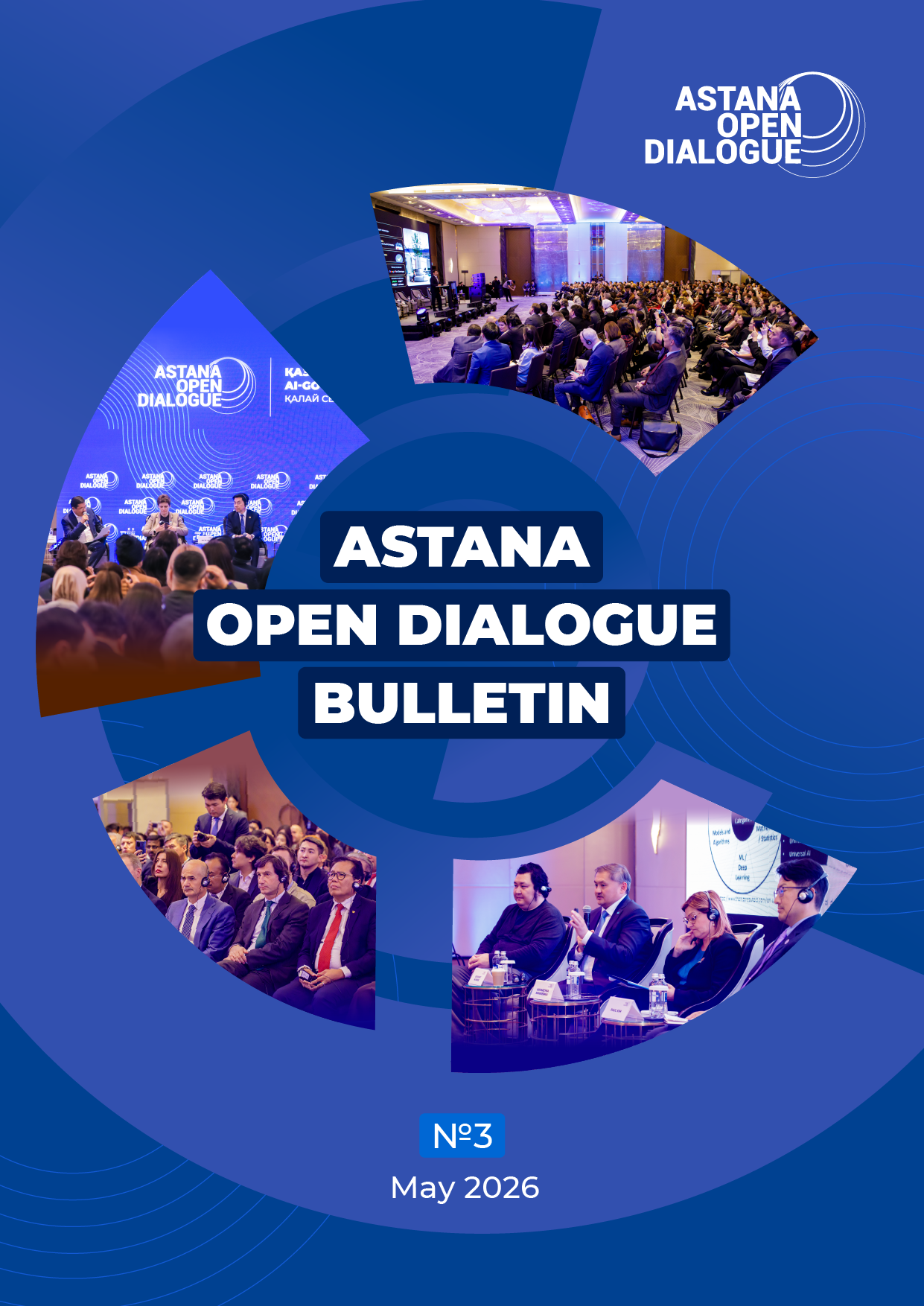
The third issue of the Astana Open Dialogue Bulletin is dedicated to the development of artificial intelligence, digital transformation, and Kazakhstan’s readiness to transition toward an intelligent model of public governance. The publication presents expert assessments, international experience, and practical recommendations developed through discussions on the future of AI-Gov, human capital, and the country’s technological policy. The report was prepared following the third meeting of Astana Open Dialogue, held on October 1, 2025, in Astana.
The first section of the report examines global trends in the development of artificial intelligence and Kazakhstan’s place within these processes. It analyzes international models for AI regulation and implementation, as well as issues related to digital sovereignty, data infrastructure, ethics, and trust in algorithmic systems. The section also explores approaches to the transition from e-Government to AI-Government and the development of a national artificial intelligence strategy.
The second section focuses on human capital and social transformation in the AI era. It addresses the modernization of education, the training of a new generation of specialists, the development of digital skills, and the adaptation of the labor market to technological change. Particular attention is given to the risks of digital inequality, the impact of AI on employment, and the need to create an inclusive digital environment.
The third section is devoted to assessing Kazakhstan’s readiness for the implementation of artificial intelligence. The report examines institutional barriers, the state of digital infrastructure, the level of public trust, and the country’s human resource capacity. It also provides recommendations for strengthening the research environment, supporting the innovation ecosystem, expanding open data policies, and enhancing cooperation among government, business, and academia.
The first section of the report examines global trends in the development of artificial intelligence and Kazakhstan’s place within these processes. It analyzes international models for AI regulation and implementation, as well as issues related to digital sovereignty, data infrastructure, ethics, and trust in algorithmic systems. The section also explores approaches to the transition from e-Government to AI-Government and the development of a national artificial intelligence strategy.
The second section focuses on human capital and social transformation in the AI era. It addresses the modernization of education, the training of a new generation of specialists, the development of digital skills, and the adaptation of the labor market to technological change. Particular attention is given to the risks of digital inequality, the impact of AI on employment, and the need to create an inclusive digital environment.
The third section is devoted to assessing Kazakhstan’s readiness for the implementation of artificial intelligence. The report examines institutional barriers, the state of digital infrastructure, the level of public trust, and the country’s human resource capacity. It also provides recommendations for strengthening the research environment, supporting the innovation ecosystem, expanding open data policies, and enhancing cooperation among government, business, and academia.