
Analytical Review Based on the Results of a Closed Expert Survey by Astana Open Dialogue "The Conflict in the Middle East and Its Impact on Kazakhstan: Risks, Consequences, and Strategic Responses"

EXECUTIVE SUMMARY
As part of a study conducted by Astana Open Dialogue, an expert survey involving 92 respondents was carried out to assess the implications of the ongoing conflict in the Middle East for the international environment and Kazakhstan.
The findings indicate that the expert community views the conflict as a significant factor affecting the dynamics of international processes and contributing to growing global instability. The conflict is perceived not as an isolated event, but as part of broader transformations within the global system.
The impact on Kazakhstan is assessed as moderate, as experts primarily point to indirect effects associated with external economic channels, logistics, and financial flows. The most vulnerable sectors identified include energy, transport and logistics, and foreign trade. This reflects the susceptibility of the country’s economic model to external shocks. Additional concerns relate to currency and investment risks, indicating expectations of increased volatility.
Experts also note the resilience of Kazakhstan’s foreign policy position under the current circumstances. The respondents’ assessments reflect an understanding that the Republic of Kazakhstan continues to maintain a balanced approach, carefully navigating its international commitments, regional stability considerations, and the protection of its national interests.
According to expert assessments, the conflict is highly likely to become protracted in nature. Such a trajectory increases uncertainty and heightens the importance of decisions aimed at medium-term resilience. Scenario assessments for Kazakhstan are dominated by expectations of economic turbulence. The most high-risk scenarios are considered to be further escalation and the expansion of the conflict, which could exert a deeper impact on both the regional and global situation.
Particular attention is also given to the information space. Experts note a high risk of disinformation and the substantial role of digital platforms in shaping public perception. This creates additional challenges for domestic stability and calls for a systematic approach to information policy.
In terms of response measures, the key priorities identified include maintaining a balanced foreign policy, strengthening domestic resilience, and diversifying economic and logistical ties.
Overall, the results point to a situation of growing external pressure in which the key challenge is not direct involvement, but the ability to adapt in a timely manner to changing conditions.
The findings indicate that the expert community views the conflict as a significant factor affecting the dynamics of international processes and contributing to growing global instability. The conflict is perceived not as an isolated event, but as part of broader transformations within the global system.
The impact on Kazakhstan is assessed as moderate, as experts primarily point to indirect effects associated with external economic channels, logistics, and financial flows. The most vulnerable sectors identified include energy, transport and logistics, and foreign trade. This reflects the susceptibility of the country’s economic model to external shocks. Additional concerns relate to currency and investment risks, indicating expectations of increased volatility.
Experts also note the resilience of Kazakhstan’s foreign policy position under the current circumstances. The respondents’ assessments reflect an understanding that the Republic of Kazakhstan continues to maintain a balanced approach, carefully navigating its international commitments, regional stability considerations, and the protection of its national interests.
According to expert assessments, the conflict is highly likely to become protracted in nature. Such a trajectory increases uncertainty and heightens the importance of decisions aimed at medium-term resilience. Scenario assessments for Kazakhstan are dominated by expectations of economic turbulence. The most high-risk scenarios are considered to be further escalation and the expansion of the conflict, which could exert a deeper impact on both the regional and global situation.
Particular attention is also given to the information space. Experts note a high risk of disinformation and the substantial role of digital platforms in shaping public perception. This creates additional challenges for domestic stability and calls for a systematic approach to information policy.
In terms of response measures, the key priorities identified include maintaining a balanced foreign policy, strengthening domestic resilience, and diversifying economic and logistical ties.
Overall, the results point to a situation of growing external pressure in which the key challenge is not direct involvement, but the ability to adapt in a timely manner to changing conditions.
INTRODUCTION
The ongoing conflict in the Middle East remains a significant source of imbalance in the international environment. According to assessments by international organizations, crises of this nature affect not only the region itself, but also the global economy through energy, trade, and financial market channels. Analytical materials published by the International Monetary Fund highlight increasing volatility and growing risks to financial stability amid geopolitical tensions[1].
Additional assessments by the World Bank indicate that conflicts of this scale lead to slower economic growth, declining investment activity, and disruptions in trade flows, including in countries that are not directly involved[2]. As a result, the impact extends beyond the immediate conflict zone and manifests itself through macroeconomic and financial channels.
For Kazakhstan, this context is particularly important given the open nature of its economy and its dependence on external markets, transport routes, and commodity prices. Even without direct involvement in the conflict, external shocks may be transmitted through changes in prices, logistical conditions, and investment flows.
Under these circumstances, expert assessment becomes increasingly important as an analytical tool. It makes it possible to capture current expectations, identify areas of vulnerability, and determine potential response directions in conditions of limited predictability. This study is aimed at analyzing how the expert community perceives the conflict and assessing its potential consequences for Kazakhstan.
[1] International Monetary Fund. War in the Middle East Challenges Global Financial Stability. IMF Blog, 14 April 2026. https://www.imf.org/en/blogs/articles/2026/04/14/war-in-the-middle-east-challenges-global-financial-stability?utm_source
[2] World Bank. Global Economic Prospects. Washington, DC: World Bank, 2024. https://documents1.worldbank.org/curated/en/099240104152411250/pdf/IDU163f1f80915d9c149081a45f19ef4a6f9bae1.pdf?utm_source
Additional assessments by the World Bank indicate that conflicts of this scale lead to slower economic growth, declining investment activity, and disruptions in trade flows, including in countries that are not directly involved[2]. As a result, the impact extends beyond the immediate conflict zone and manifests itself through macroeconomic and financial channels.
For Kazakhstan, this context is particularly important given the open nature of its economy and its dependence on external markets, transport routes, and commodity prices. Even without direct involvement in the conflict, external shocks may be transmitted through changes in prices, logistical conditions, and investment flows.
Under these circumstances, expert assessment becomes increasingly important as an analytical tool. It makes it possible to capture current expectations, identify areas of vulnerability, and determine potential response directions in conditions of limited predictability. This study is aimed at analyzing how the expert community perceives the conflict and assessing its potential consequences for Kazakhstan.
[1] International Monetary Fund. War in the Middle East Challenges Global Financial Stability. IMF Blog, 14 April 2026. https://www.imf.org/en/blogs/articles/2026/04/14/war-in-the-middle-east-challenges-global-financial-stability?utm_source
[2] World Bank. Global Economic Prospects. Washington, DC: World Bank, 2024. https://documents1.worldbank.org/curated/en/099240104152411250/pdf/IDU163f1f80915d9c149081a45f19ef4a6f9bae1.pdf?utm_source
METHODOLOGY
The study is based on the results of an expert survey conducted by Astana Open Dialogue to assess perceptions of the ongoing conflict in the Middle East and its potential implications for Kazakhstan.
The survey was conducted in the form of an online questionnaire. A total of 92 respondents participated, representing a range of professional fields, including public administration, analytics, academia, business, and the research sector. This composition made it possible to collect interdisciplinary assessments and capture a broad spectrum of expert opinions.
The questionnaire included both closed-ended and open-ended questions. The closed-ended questions were designed to provide a quantitative assessment of the significance of the conflict, its impact on the international system and Kazakhstan, as well as to identify the most vulnerable sectors, possible development scenarios, and priority response measures. For some questions, respondents evaluated the intensity of the impact and the level of risks using a scale from 1 to 5.
The open-ended questions made it possible to capture experts’ reasoning in greater detail, clarify perceptions of the most high-risk scenarios, and collect proposals regarding possible actions on the part of Kazakhstan. The responses obtained were analyzed using a qualitative approach and grouped into thematic categories.
Data processing included the initial cleaning of the dataset, systematization of responses, and subsequent quantitative analysis based on key variables. For multiple-choice questions, respondents were allowed to select more than one option; therefore, the total values across certain categories may exceed 100 percent.
It should be noted that the findings reflect expert assessments and are not intended to be representative of the population as a whole. Nevertheless, they provide valuable insight into the current expectations of the professional community and help identify the main directions in the perception of risks and potential consequences.
The limitations of the study are related to the nature of the sample and the subjective character of expert assessments, as well as to the dynamic nature of the international political environment, which may affect the relevance of certain conclusions over time.
The survey was conducted in the form of an online questionnaire. A total of 92 respondents participated, representing a range of professional fields, including public administration, analytics, academia, business, and the research sector. This composition made it possible to collect interdisciplinary assessments and capture a broad spectrum of expert opinions.
The questionnaire included both closed-ended and open-ended questions. The closed-ended questions were designed to provide a quantitative assessment of the significance of the conflict, its impact on the international system and Kazakhstan, as well as to identify the most vulnerable sectors, possible development scenarios, and priority response measures. For some questions, respondents evaluated the intensity of the impact and the level of risks using a scale from 1 to 5.
The open-ended questions made it possible to capture experts’ reasoning in greater detail, clarify perceptions of the most high-risk scenarios, and collect proposals regarding possible actions on the part of Kazakhstan. The responses obtained were analyzed using a qualitative approach and grouped into thematic categories.
Data processing included the initial cleaning of the dataset, systematization of responses, and subsequent quantitative analysis based on key variables. For multiple-choice questions, respondents were allowed to select more than one option; therefore, the total values across certain categories may exceed 100 percent.
It should be noted that the findings reflect expert assessments and are not intended to be representative of the population as a whole. Nevertheless, they provide valuable insight into the current expectations of the professional community and help identify the main directions in the perception of risks and potential consequences.
The limitations of the study are related to the nature of the sample and the subjective character of expert assessments, as well as to the dynamic nature of the international political environment, which may affect the relevance of certain conclusions over time.
1. GENERAL ASSESSMENT OF THE SITUATION
The survey results demonstrate that experts perceive the current conflict in the Middle East as a significant factor affecting the international environment. A scale from 1 to 5 was used for the assessment, where 1 indicated minimal impact and 5 represented the highest possible level of impact.
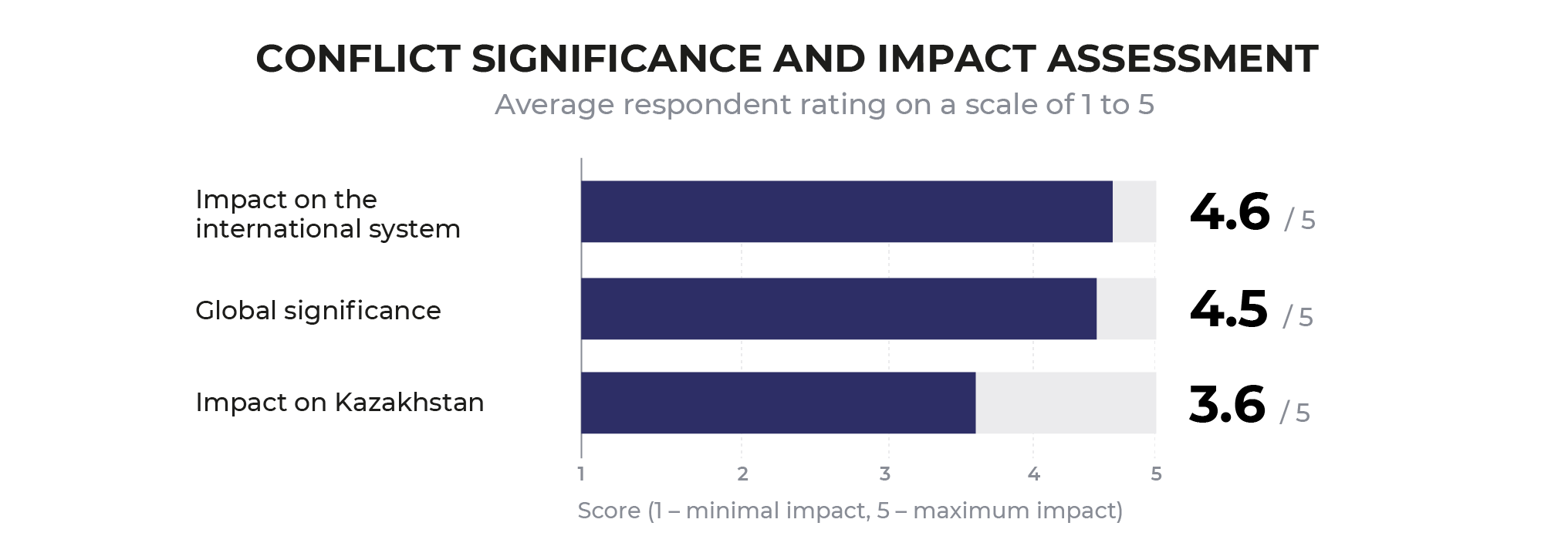
The results suggest that the conflict is viewed as a factor with a high degree of global influence. Assessments of its impact on the international system are similarly high, reflecting the perception of the conflict as an event affecting the behavior of states, markets, and foreign policy processes.
At the same time, the assessment of its impact on Kazakhstan is noticeably lower. This indicates that experts primarily identify indirect forms of influence. In their view, the main effects are transmitted through economic, logistical, and financial channels rather than through direct security risks.
Regarding the expected timeframe of the conflict, the prevailing view points toward a medium-term development scenario; however, the distribution of responses reflects the existence of different scenario expectations.
At the same time, the assessment of its impact on Kazakhstan is noticeably lower. This indicates that experts primarily identify indirect forms of influence. In their view, the main effects are transmitted through economic, logistical, and financial channels rather than through direct security risks.
Regarding the expected timeframe of the conflict, the prevailing view points toward a medium-term development scenario; however, the distribution of responses reflects the existence of different scenario expectations.
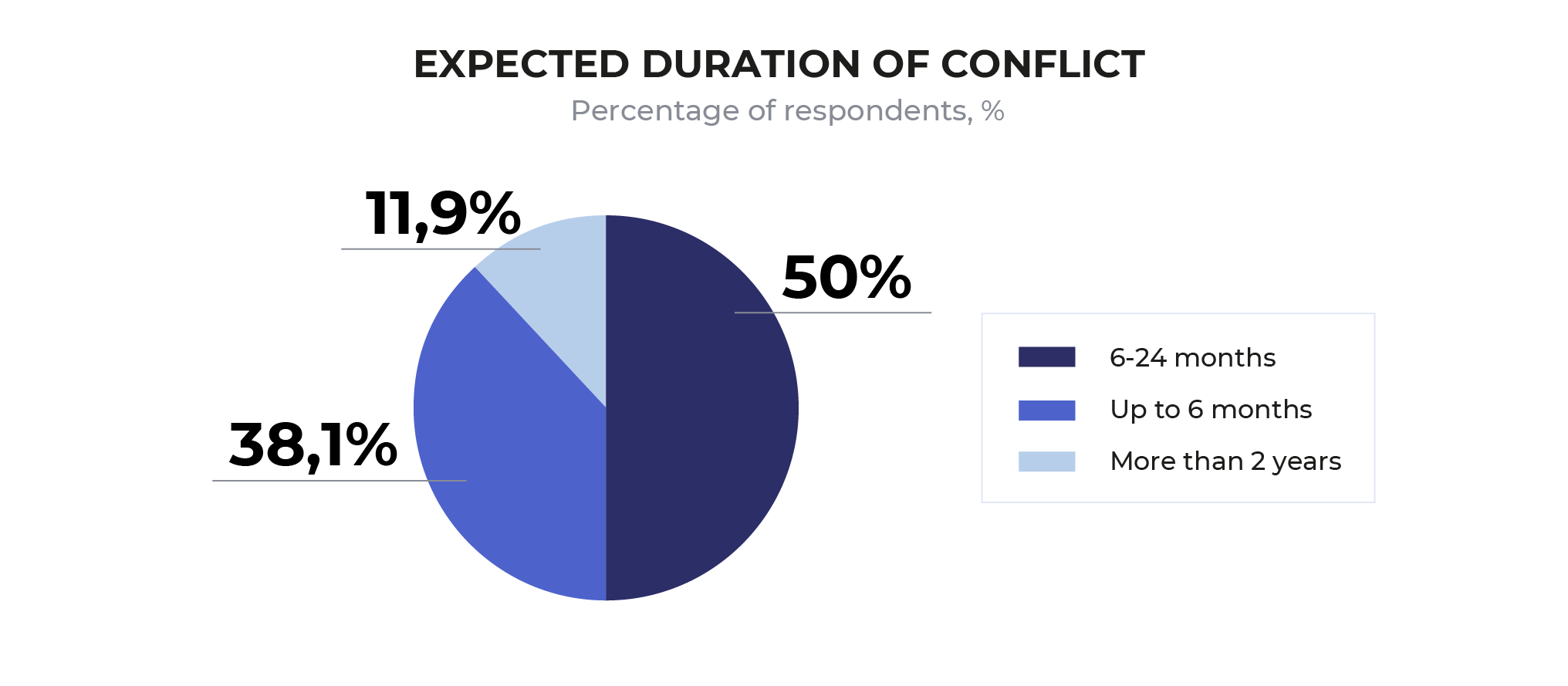

Approximately half of the respondents expect the active phase of the conflict to continue for one to two years. At the same time, a considerable share of experts points out a more short-term trajectory, highlighting the continuing uncertainty surrounding the situation. Long-term scenarios are mentioned less frequently, though their presence indicates that the risk of prolonged instability is also being taken into account.
An additional dimension concerns perceptions of the economic consequences. Most respondents characterize the impact of the conflict on Kazakhstan’s economy as moderate (54.8%), while a significant proportion of experts describe it as substantial (42.9%). Only a very small number of respondents consider the impact to be insignificant. The predominance of assessments ranging from moderate to substantial is consistent with the broader understanding of indirect influence through external channels. This suggests that even without direct involvement, Kazakhstan is already experiencing the effects of external instability.
Overall, expert assessments point to a situation in which Kazakhstan is not located within the zone of direct risk, but is nevertheless integrated into the broader system of consequences through economic and external channels. This provides the basis for further analysis of more specific risks and possible scenarios.
An additional dimension concerns perceptions of the economic consequences. Most respondents characterize the impact of the conflict on Kazakhstan’s economy as moderate (54.8%), while a significant proportion of experts describe it as substantial (42.9%). Only a very small number of respondents consider the impact to be insignificant. The predominance of assessments ranging from moderate to substantial is consistent with the broader understanding of indirect influence through external channels. This suggests that even without direct involvement, Kazakhstan is already experiencing the effects of external instability.
Overall, expert assessments point to a situation in which Kazakhstan is not located within the zone of direct risk, but is nevertheless integrated into the broader system of consequences through economic and external channels. This provides the basis for further analysis of more specific risks and possible scenarios.
2. KEY RISKS FOR KAZAKHSTAN
Expert assessments indicate that the impact of the current conflict on Kazakhstan is manifested primarily through indirect channels. The risks are concentrated in the economic, geopolitical, and informational spheres, while their nature suggests a gradual but growing impact.
2.1 Economic Risks
The economic dimension represents the primary channel of influence. Respondents’ answers clearly demonstrate a concentration of risks in sectors connected to external markets and cross-border flows.
2.1 Economic Risks
The economic dimension represents the primary channel of influence. Respondents’ answers clearly demonstrate a concentration of risks in sectors connected to external markets and cross-border flows.
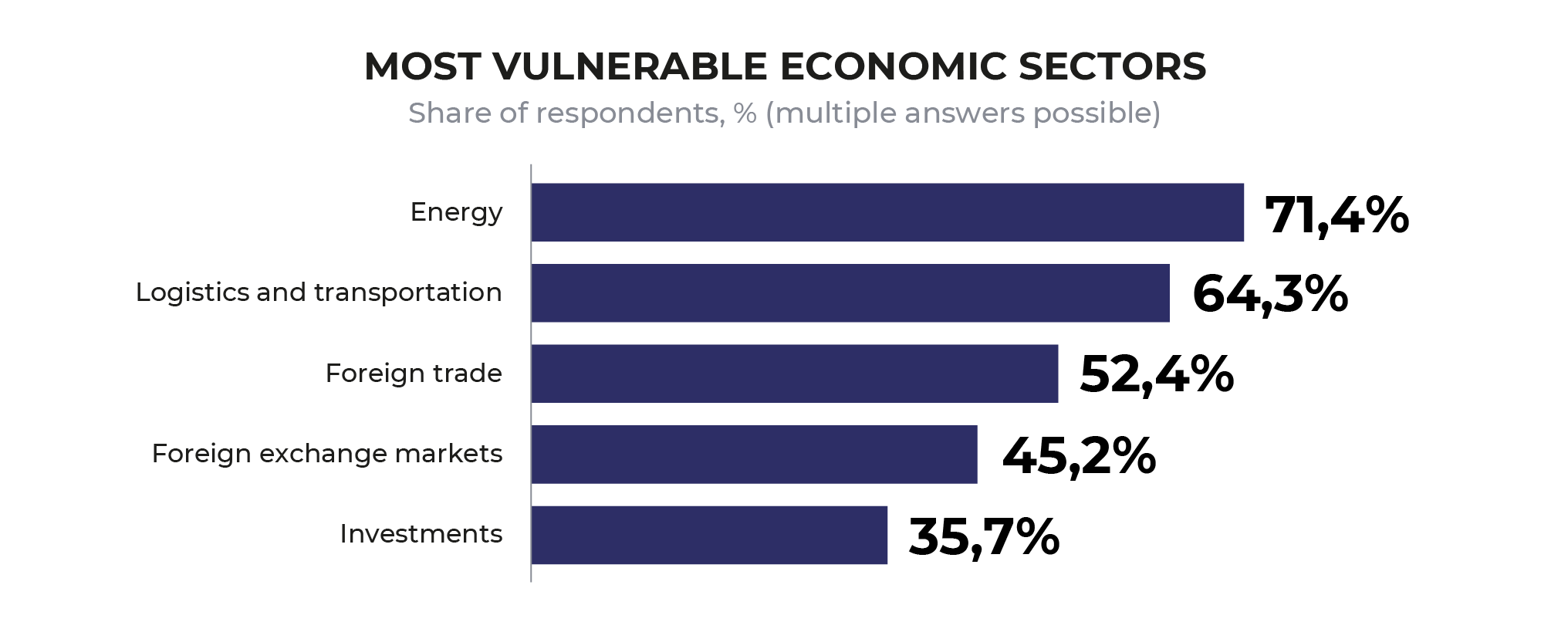
The distribution of responses indicates that the key risks are associated with possible fluctuations in commodity prices, changes in transportation conditions, and growing uncertainty in trade flows. The prominence of the energy sector reflects sensitivity to global price dynamics, while the emphasis on logistics and transport points to the vulnerability of transit routes and supply chains.
The financial sector also occupies a significant place in expert assessments. References to currency markets and investment indicate expectations of increased volatility, potential capital outflows, and declining investment activity. Taken together, these factors create the risk of a slowdown in economic dynamics.
The financial sector also occupies a significant place in expert assessments. References to currency markets and investment indicate expectations of increased volatility, potential capital outflows, and declining investment activity. Taken together, these factors create the risk of a slowdown in economic dynamics.
2.2 Geopolitical Risks
Despite the absence of direct involvement in the conflict, Kazakhstan is affected by changes in the international environment caused by the ongoing crisis. Expert assessments point to rising uncertainty and the increasing complexity of the foreign policy context.
An analysis of respondents’ open-ended answers shows that geopolitical risks are perceived through several key dimensions.
First, experts note the risk of growing pressure from major international actors. In the context of escalating conflict, states may pursue their interests more actively, including in relation to countries pursuing a multi-vector foreign policy. This increases the demands placed on balancing foreign policy positions.
Second, a number of responses reflect expectations of a broader expansion of the conflict. Experts refer to scenarios involving the engagement of additional countries and the transformation of the crisis into a larger-scale phase. Such a scenario is regarded as one of the most dangerous and could significantly alter both regional and global dynamics.
Third, respondents highlight the changing role of regions and transit spaces. Amid growing instability, the importance of alternative routes and logistical corridors is increasing, which may create both opportunities and risks for Kazakhstan. On the one hand, this enhances the country’s strategic significance; on the other, it increases its sensitivity to external developments.
Respondents also separately mention the risk of migration pressure and humanitarian consequences that could emerge if the situation in the region deteriorates further. Although this factor is not viewed as dominant, it is considered a potential element of broader geopolitical shifts.
Thus, the geopolitical risks facing Kazakhstan are associated not with direct threats, but with transformations in the external environment that require more precise and flexible foreign policy management. Their nature points to the need to preserve balance, adapt to changing conditions, and strengthen the analytical support underpinning policy decisions.
Despite the absence of direct involvement in the conflict, Kazakhstan is affected by changes in the international environment caused by the ongoing crisis. Expert assessments point to rising uncertainty and the increasing complexity of the foreign policy context.
An analysis of respondents’ open-ended answers shows that geopolitical risks are perceived through several key dimensions.
First, experts note the risk of growing pressure from major international actors. In the context of escalating conflict, states may pursue their interests more actively, including in relation to countries pursuing a multi-vector foreign policy. This increases the demands placed on balancing foreign policy positions.
Second, a number of responses reflect expectations of a broader expansion of the conflict. Experts refer to scenarios involving the engagement of additional countries and the transformation of the crisis into a larger-scale phase. Such a scenario is regarded as one of the most dangerous and could significantly alter both regional and global dynamics.
Third, respondents highlight the changing role of regions and transit spaces. Amid growing instability, the importance of alternative routes and logistical corridors is increasing, which may create both opportunities and risks for Kazakhstan. On the one hand, this enhances the country’s strategic significance; on the other, it increases its sensitivity to external developments.
Respondents also separately mention the risk of migration pressure and humanitarian consequences that could emerge if the situation in the region deteriorates further. Although this factor is not viewed as dominant, it is considered a potential element of broader geopolitical shifts.
Thus, the geopolitical risks facing Kazakhstan are associated not with direct threats, but with transformations in the external environment that require more precise and flexible foreign policy management. Their nature points to the need to preserve balance, adapt to changing conditions, and strengthen the analytical support underpinning policy decisions.
2.3 Social and Domestic Risks
In expert assessments, social and domestic risks are not viewed as dominant; however, their significance increases in the context of a prolonged conflict and intensifying external informational influence. Unlike economic factors, these risks manifest themselves less directly, yet they are capable of producing a cumulative effect over time.
The information environment is identified as the key channel through which domestic risks emerge. Experts note that public perceptions of the conflict within the country are shaped to a large extent through digital platforms, where multiple interpretations of ongoing events circulate. This increases the sensitivity of public sentiment to external agendas.
An additional factor is the high risk of disinformation, which is consistently reflected in respondents’ assessments. The spread of unverified or distorted information may intensify emotional reactions and create conditions for the fragmentation of public perception.
Against this backdrop, the likelihood of polarization of opinions on foreign policy issues and international events increases. Although such processes are not currently systemic in nature, they may intensify if the conflict becomes prolonged and informational pressure continues to grow.
Respondents also place particular emphasis on the issue of domestic stability. Among the priorities Kazakhstan should take into account in the current situation, experts frequently mention the importance of maintaining social calm, ensuring a restrained response to external developments, and preventing internal tensions. This indicates that social resilience is perceived as an important component of the broader response strategy.
Thus, social risks emerge at the intersection of informational influence and public sentiment. Their specific nature lies in the fact that they develop gradually and depend largely on the quality of the information environment and the effectiveness of governance decisions. Under these conditions, the key challenge is not only responding to external developments, but also managing domestic perceptions and maintaining public trust.
In expert assessments, social and domestic risks are not viewed as dominant; however, their significance increases in the context of a prolonged conflict and intensifying external informational influence. Unlike economic factors, these risks manifest themselves less directly, yet they are capable of producing a cumulative effect over time.
The information environment is identified as the key channel through which domestic risks emerge. Experts note that public perceptions of the conflict within the country are shaped to a large extent through digital platforms, where multiple interpretations of ongoing events circulate. This increases the sensitivity of public sentiment to external agendas.
An additional factor is the high risk of disinformation, which is consistently reflected in respondents’ assessments. The spread of unverified or distorted information may intensify emotional reactions and create conditions for the fragmentation of public perception.
Against this backdrop, the likelihood of polarization of opinions on foreign policy issues and international events increases. Although such processes are not currently systemic in nature, they may intensify if the conflict becomes prolonged and informational pressure continues to grow.
Respondents also place particular emphasis on the issue of domestic stability. Among the priorities Kazakhstan should take into account in the current situation, experts frequently mention the importance of maintaining social calm, ensuring a restrained response to external developments, and preventing internal tensions. This indicates that social resilience is perceived as an important component of the broader response strategy.
Thus, social risks emerge at the intersection of informational influence and public sentiment. Their specific nature lies in the fact that they develop gradually and depend largely on the quality of the information environment and the effectiveness of governance decisions. Under these conditions, the key challenge is not only responding to external developments, but also managing domestic perceptions and maintaining public trust.
2.4 Information Risks
Experts view the information environment as an independent channel of influence that amplifies the impact of external factors on domestic processes. In the context of the rapid dissemination of content through digital platforms, public perception is increasingly shaped outside traditional information sources.
Experts view the information environment as an independent channel of influence that amplifies the impact of external factors on domestic processes. In the context of the rapid dissemination of content through digital platforms, public perception is increasingly shaped outside traditional information sources.
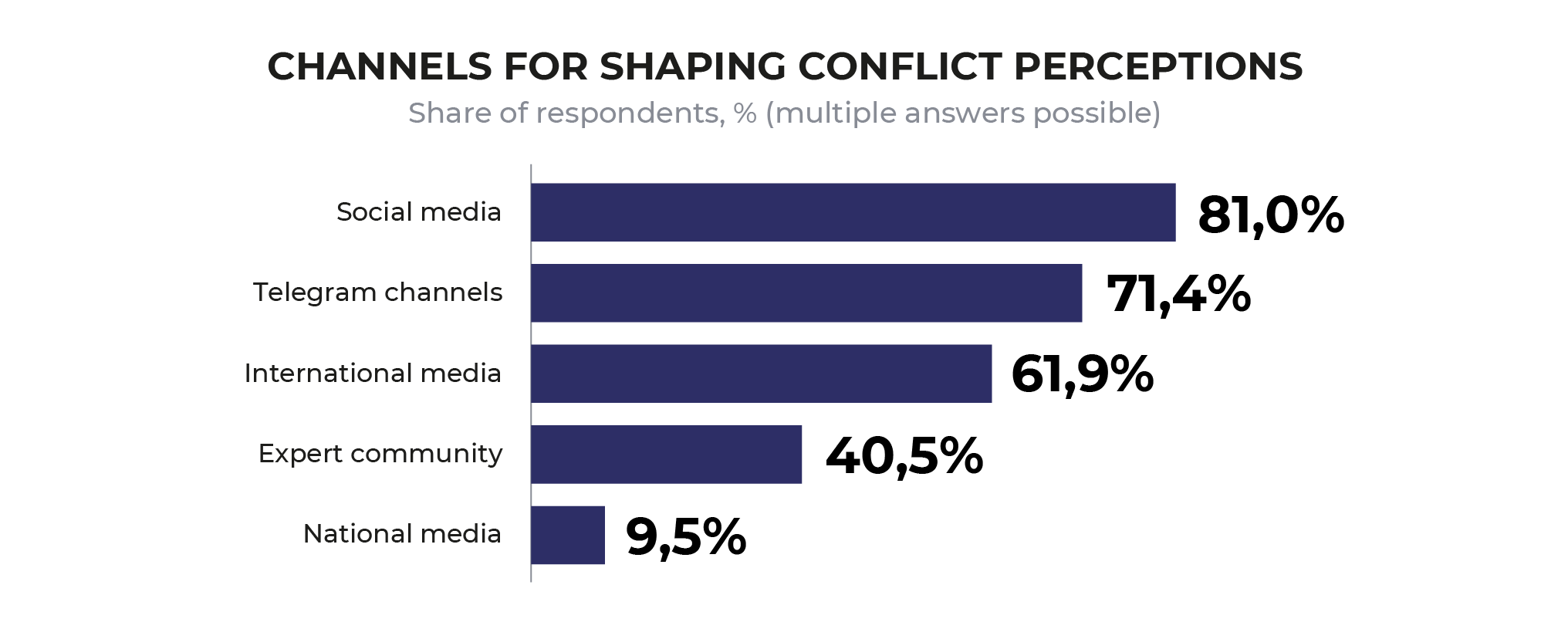
The distribution of responses indicates that digital platforms – primarily social media and Telegram channels – play the central role in shaping perceptions. At the same time, international media outlets continue to retain significant influence. In contrast, national media are mentioned considerably less frequently, which may indicate a shift in information consumption toward alternative sources.
Against this backdrop, the issue of disinformation acquires particular importance and is regarded by experts as one of the principal risks.
Against this backdrop, the issue of disinformation acquires particular importance and is regarded by experts as one of the principal risks.
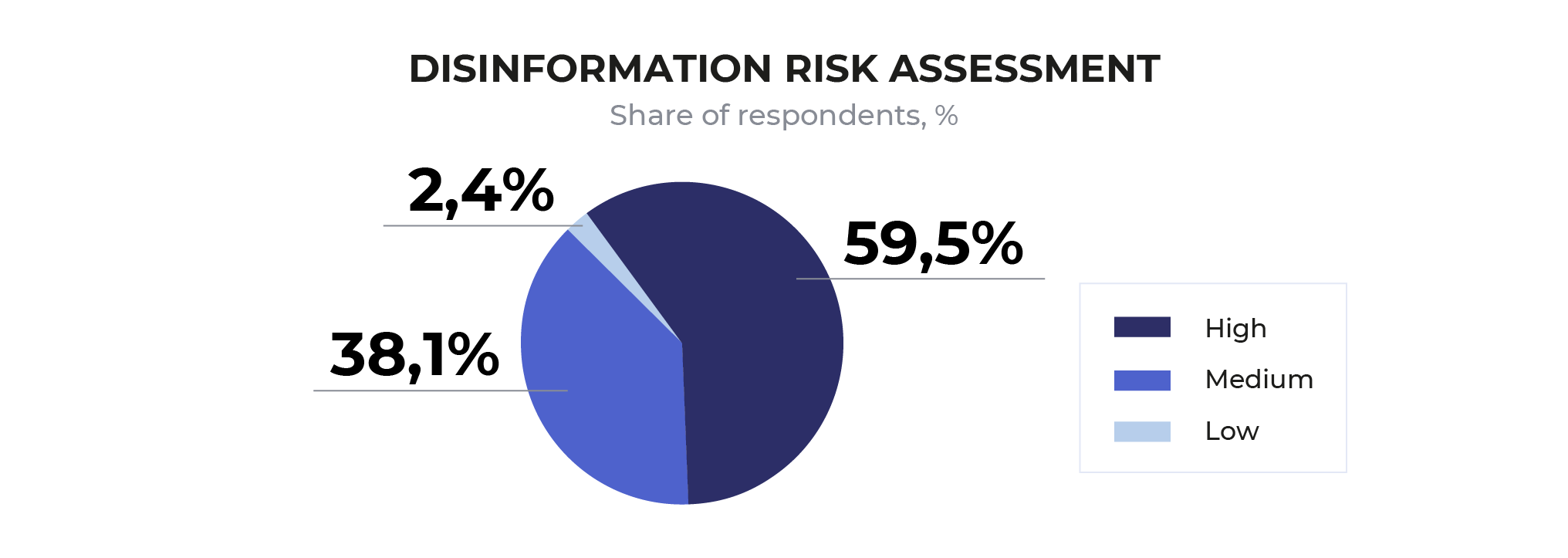
The predominance of assessments indicating medium to high levels of risk suggests that the information environment is perceived as unstable and vulnerable to distortion. This creates additional challenges related to the formation of public sentiment and the interpretation of foreign policy developments.
Thus, information risks emerge at the intersection of the growing role of digital communication channels and the substantial presence of unreliable or interpretive content. Under these conditions, the importance of systematic work with the information agenda increases, alongside the need to develop critical information literacy skills.
Thus, information risks emerge at the intersection of the growing role of digital communication channels and the substantial presence of unreliable or interpretive content. Under these conditions, the importance of systematic work with the information agenda increases, alongside the need to develop critical information literacy skills.
3. SCENARIOS FOR THE DEVELOPMENT OF THE SITUATION
Expert assessments make it possible to identify both the most likely and the most high-risk scenarios for Kazakhstan. Unlike the previous sections, the focus here shifts from describing the current situation to expectations and forecasts.
3.1 Most Likely Scenarios
The distribution of responses indicates that experts primarily expect the conflict to generate economic consequences.
3.1 Most Likely Scenarios
The distribution of responses indicates that experts primarily expect the conflict to generate economic consequences.
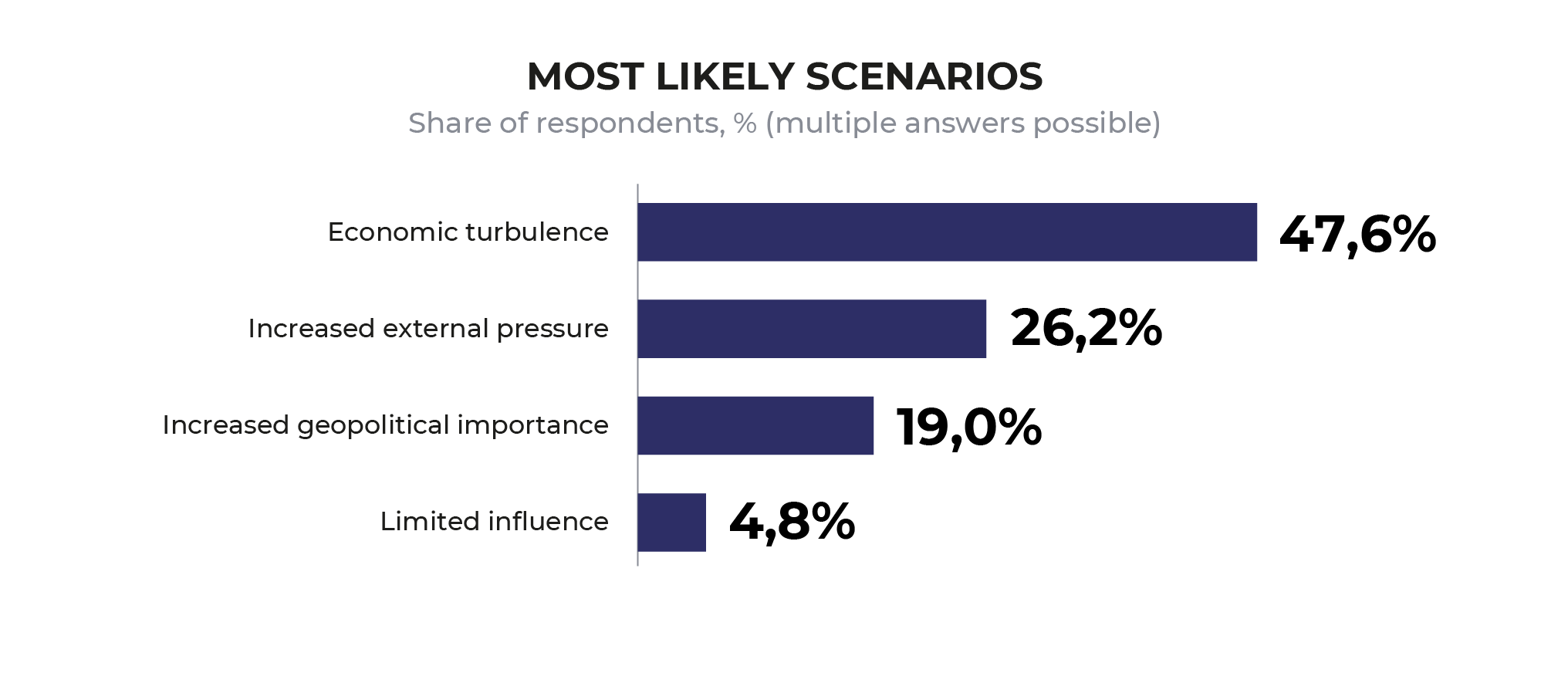
Nearly half of the respondents view a scenario of economic turbulence as the most likely outcome. This is consistent with earlier assessments, where economic risks emerged as the principal channel of impact.
The scenario involving increased external pressure ranks second and reflects expectations of a more complex foreign policy environment. At the same time, the anticipated growth in geopolitical significance suggests that the situation is perceived not only as a source of risks, but also as a potential window of opportunity.
The relatively low share of responses supporting a scenario of limited impact indicates that the majority of experts do not regard the current situation as insignificant for Kazakhstan.
The scenario involving increased external pressure ranks second and reflects expectations of a more complex foreign policy environment. At the same time, the anticipated growth in geopolitical significance suggests that the situation is perceived not only as a source of risks, but also as a potential window of opportunity.
The relatively low share of responses supporting a scenario of limited impact indicates that the majority of experts do not regard the current situation as insignificant for Kazakhstan.
3.2 Most High-Risk Scenarios
Unlike the probable scenarios, responses regarding the most high-risk developments were open-ended and revealed a considerably broader spectrum of concerns. Analysis of the responses allows several stable categories of risks to be identified.
Most frequently, experts pointed to scenarios involving further escalation of the conflict and its expansion beyond the current zone of confrontation. A number of respondents mentioned the possibility of additional states becoming involved and the conflict evolving into a larger-scale phase, including “a more prolonged conflict with Iran that spreads to the territory of other Middle Eastern states”, as well as the risk of a “global conflict” and the “spillover of military operations into the Caspian region”.
Unlike the probable scenarios, responses regarding the most high-risk developments were open-ended and revealed a considerably broader spectrum of concerns. Analysis of the responses allows several stable categories of risks to be identified.
Most frequently, experts pointed to scenarios involving further escalation of the conflict and its expansion beyond the current zone of confrontation. A number of respondents mentioned the possibility of additional states becoming involved and the conflict evolving into a larger-scale phase, including “a more prolonged conflict with Iran that spreads to the territory of other Middle Eastern states”, as well as the risk of a “global conflict” and the “spillover of military operations into the Caspian region”.

A separate category of risks is associated with regional destabilization and disruptions to transport and logistics connections. Experts draw attention to Kazakhstan’s high dependence on external routes and the potential consequences for export corridors. One respondent noted that “regional destabilization carries the risk of a complete loss of transport and logistics routes due to the paralysis of the southern corridor”.
Additional concerns relate to the humanitarian consequences of the conflict. Responses mention “flows of refugees”, “migration flows and terrorism risks”, as well as the possibility of increasing instability amid a humanitarian crisis.
Some experts also emphasize risks to energy infrastructure and the potential impact of the conflict on the oil and gas sector, including “strikes on oil infrastructure” and the expansion of the conflict to energy projects in the region.
Thus, in the perception of experts, the most dangerous scenarios extend beyond purely economic consequences and encompass a broader range of regional, humanitarian, and geopolitical factors.
Additional concerns relate to the humanitarian consequences of the conflict. Responses mention “flows of refugees”, “migration flows and terrorism risks”, as well as the possibility of increasing instability amid a humanitarian crisis.
Some experts also emphasize risks to energy infrastructure and the potential impact of the conflict on the oil and gas sector, including “strikes on oil infrastructure” and the expansion of the conflict to energy projects in the region.
Thus, in the perception of experts, the most dangerous scenarios extend beyond purely economic consequences and encompass a broader range of regional, humanitarian, and geopolitical factors.

4. KAZAKHSTAN’S STRATEGIC PRIORITIES
Respondents’ answers indicate that, amid persistent external uncertainty, the key priority is strengthening the state’s resilience to external shocks. In expert assessments, Kazakhstan’s priorities are associated not with short-term reactions to individual events, but with maintaining balance, governance capacity, and the ability to adapt to a changing international environment.
4.1 Foreign Policy Balance
The most consistent theme in respondents’ answers is support for a balanced foreign policy course. Experts emphasize the importance of preserving a multi-vector foreign policy, maintaining diplomatic flexibility, and distancing the country from confrontational dynamics.
A number of responses stress the need to “avoid being drawn in other people’s conflicts”, maintain constructive relations with different centers of power, and refrain from abrupt foreign policy moves amid an unstable international environment.
Respondents additionally highlight the importance of diplomatic instruments and international dialogue as means of reducing external pressure and maintaining predictability.
4.1 Foreign Policy Balance
The most consistent theme in respondents’ answers is support for a balanced foreign policy course. Experts emphasize the importance of preserving a multi-vector foreign policy, maintaining diplomatic flexibility, and distancing the country from confrontational dynamics.
A number of responses stress the need to “avoid being drawn in other people’s conflicts”, maintain constructive relations with different centers of power, and refrain from abrupt foreign policy moves amid an unstable international environment.
Respondents additionally highlight the importance of diplomatic instruments and international dialogue as means of reducing external pressure and maintaining predictability.
4.2 Economic Resilience
The economic dimension occupies a central place in expert assessments. Respondents consistently emphasize the need to reduce dependence on individual routes, markets, and external factors.
Particular attention is paid to the diversification of logistical directions, the development of alternative transport corridors, and the strengthening of domestic economic resilience. Several responses directly point to the need to “diversify markets” and expand opportunities for more independent economic development.
Experts also note that the current situation may not only create risks, but also open new opportunities for strengthening Kazakhstan’s transit and regional role.
The economic dimension occupies a central place in expert assessments. Respondents consistently emphasize the need to reduce dependence on individual routes, markets, and external factors.
Particular attention is paid to the diversification of logistical directions, the development of alternative transport corridors, and the strengthening of domestic economic resilience. Several responses directly point to the need to “diversify markets” and expand opportunities for more independent economic development.
Experts also note that the current situation may not only create risks, but also open new opportunities for strengthening Kazakhstan’s transit and regional role.
4.3 Information and Social Resilience
Respondents devote significant attention to issues of domestic stability and the information environment. Experts stress the importance of a restrained response to external developments and the prevention of rising internal tensions.
Several responses identify the need to “maintain calm”, strengthen social resilience, and pay greater attention to the quality of the information environment as key priorities.
Given the growing role of social networks and digital platforms, the development of media literacy and the reduction of vulnerability to disinformation become especially important.
Respondents devote significant attention to issues of domestic stability and the information environment. Experts stress the importance of a restrained response to external developments and the prevention of rising internal tensions.
Several responses identify the need to “maintain calm”, strengthen social resilience, and pay greater attention to the quality of the information environment as key priorities.
Given the growing role of social networks and digital platforms, the development of media literacy and the reduction of vulnerability to disinformation become especially important.
4.4 Readiness for Crisis Scenarios
Although the military dimension does not dominate expert assessments, some respondents draw attention to the need for readiness in the event of a deterioration of the regional situation.
Responses mention issues such as strategic planning, interagency coordination, and preparation for various possible developments. Particular emphasis is placed on the importance of the ability to adapt quickly to changes in the external environment and maintain the resilience of key systems during periods of crisis.
Overall, expert assessments indicate that Kazakhstan’s strategic priorities under current conditions are primarily associated with preserving resilience and flexibility. The key emphasis is placed on maintaining foreign policy balance, strengthening economic self-sufficiency, reducing information-related risks, and ensuring preparedness for a potential deterioration of the external environment.
Although the military dimension does not dominate expert assessments, some respondents draw attention to the need for readiness in the event of a deterioration of the regional situation.
Responses mention issues such as strategic planning, interagency coordination, and preparation for various possible developments. Particular emphasis is placed on the importance of the ability to adapt quickly to changes in the external environment and maintain the resilience of key systems during periods of crisis.
Overall, expert assessments indicate that Kazakhstan’s strategic priorities under current conditions are primarily associated with preserving resilience and flexibility. The key emphasis is placed on maintaining foreign policy balance, strengthening economic self-sufficiency, reducing information-related risks, and ensuring preparedness for a potential deterioration of the external environment.

CONCLUSION
The results of the expert survey demonstrate that the current conflict in the Middle East is perceived not as a localized crisis, but as a factor capable of exerting a long-term influence on international processes, economic ties, and the information environment.
For Kazakhstan, the primary significance lies not in the direct consequences of the conflict, but in its indirect impact through external economic, logistical, and political channels. Expert assessments are dominated by the perception of the situation as a source of growing uncertainty that requires greater resilience and adaptability on the part of the state.
The sectors identified as the most vulnerable include energy, logistics, foreign trade, and the financial sphere. At the same time, considerable attention is devoted to information-related risks, including the high level of disinformation and the influence of digital platforms on shaping public perception.
Scenario assessments indicate that economic turbulence is viewed as the most likely consequence for Kazakhstan, while the most high-risk scenarios are associated with further escalation of the conflict, the expansion of instability, and disruptions to regional connections.
Under these conditions, maintaining a balanced foreign policy, diversifying economic and logistical routes, strengthening domestic resilience, and ensuring the ability to adapt quickly to changes in the external environment become particularly important.
Overall, the findings of the study point to the need for a long-term approach to managing external risks. In conditions of heightened international uncertainty, resilience is increasingly determined not by the absence of external pressure, but by the state’s ability to respond effectively to rapidly changing circumstances.
For Kazakhstan, the primary significance lies not in the direct consequences of the conflict, but in its indirect impact through external economic, logistical, and political channels. Expert assessments are dominated by the perception of the situation as a source of growing uncertainty that requires greater resilience and adaptability on the part of the state.
The sectors identified as the most vulnerable include energy, logistics, foreign trade, and the financial sphere. At the same time, considerable attention is devoted to information-related risks, including the high level of disinformation and the influence of digital platforms on shaping public perception.
Scenario assessments indicate that economic turbulence is viewed as the most likely consequence for Kazakhstan, while the most high-risk scenarios are associated with further escalation of the conflict, the expansion of instability, and disruptions to regional connections.
Under these conditions, maintaining a balanced foreign policy, diversifying economic and logistical routes, strengthening domestic resilience, and ensuring the ability to adapt quickly to changes in the external environment become particularly important.
Overall, the findings of the study point to the need for a long-term approach to managing external risks. In conditions of heightened international uncertainty, resilience is increasingly determined not by the absence of external pressure, but by the state’s ability to respond effectively to rapidly changing circumstances.