Analytical Review Based on the Results of a Closed Expert Survey Astana Open Dialogue "Kazakhstan’s Readiness for the Transition to Artificial Intelligence and Digitalization"
A closed expert survey on “Kazakhstan’s Readiness for the Transition to Artificial Intelligence and Digitalization” was conducted from 3 to 13 November 2025. The study involved 140 respondents representing the public sector, political parties and members of Parliament, as well as the private sector, academic and educational institutions, think tanks, industry associations, IT companies, and the independent expert community.
The key context for conducting this study was the III meeting of the independent analytical platform Astana Open Dialogue, titled “Kazakhstan on the Path from e-gov to AI-gov: How to Make a Breakthrough?”, held on October 1, 2025. The event brought together Members of the Parliament of the Republic of Kazakhstan, ambassadors of foreign states, representatives of international organizations, recognized artificial intelligence experts, as well as leading scholars and university rectors from across Kazakhstan. It was during this meeting that participants noted Kazakhstan’s entry into a new phase of digital governance development, in which legislative frameworks, infrastructure, human capital, and the ethical use of technology play a central role. The expert survey conducted subsequently became a logical extension of these discussions and a tool for obtaining a structured perspective from the professional community on the key challenges and opportunities associated with the transition to AI-Gov.
The expert sample covers a broad range of professional fields related to digitalization, public policy, education, research, economics, the IT sector, and civic initiatives. Such an interdisciplinary group of experts made it possible to obtain a multi-layered view of the introduction of artificial intelligence in Kazakhstan, encompassing both technological approaches and the socio-humanitarian dimensions of this process.
A closed expert survey on “Kazakhstan’s Readiness for the Transition to Artificial Intelligence and Digitalization” was conducted from 3 to 13 November 2025. The study involved 140 respondents representing the public sector, political parties and members of Parliament, as well as the private sector, academic and educational institutions, think tanks, industry associations, IT companies, and the independent expert community.
The key context for conducting this study was the III meeting of the independent analytical platform Astana Open Dialogue, titled “Kazakhstan on the Path from e-gov to AI-gov: How to Make a Breakthrough?”, held on October 1, 2025. The event brought together Members of the Parliament of the Republic of Kazakhstan, ambassadors of foreign states, representatives of international organizations, recognized artificial intelligence experts, as well as leading scholars and university rectors from across Kazakhstan. It was during this meeting that participants noted Kazakhstan’s entry into a new phase of digital governance development, in which legislative frameworks, infrastructure, human capital, and the ethical use of technology play a central role. The expert survey conducted subsequently became a logical extension of these discussions and a tool for obtaining a structured perspective from the professional community on the key challenges and opportunities associated with the transition to AI-Gov.
The expert sample covers a broad range of professional fields related to digitalization, public policy, education, research, economics, the IT sector, and civic initiatives. Such an interdisciplinary group of experts made it possible to obtain a multi-layered view of the introduction of artificial intelligence in Kazakhstan, encompassing both technological approaches and the socio-humanitarian dimensions of this process.
The survey methodology included scale-based assessments, multiple-choice questions, and open-ended comments, ensuring a combination of quantitative analysis and qualitative expert insights. Respondents were asked to:
–assess Kazakhstan’s readiness to integrate artificial intelligence into public administration;
–identify the key drivers of optimism, risks, and more systemic barriers;
–determine the areas with the greatest potential and the sectors least prepared for transformation;
–describe their own involvement and readiness to use artificial intelligence;
–formulate recommendations for accelerating artificial intelligence adoption and ensuring its ethical implementation.
The structure of the questions made it possible to trace both the overall perception of artificial intelligence within the professional community and the differences between sectors – between those directly involved in implementing artificial intelligence and those whose interaction with the technologies is more analytical or observational in nature.
The data obtained provides a foundation for understanding where Kazakhstan stands today, which institutional and social factors shape the pace of technology adoption, and which steps should be prioritized for transitioning to a more mature and sustainable AI-Gov model.
–assess Kazakhstan’s readiness to integrate artificial intelligence into public administration;
–identify the key drivers of optimism, risks, and more systemic barriers;
–determine the areas with the greatest potential and the sectors least prepared for transformation;
–describe their own involvement and readiness to use artificial intelligence;
–formulate recommendations for accelerating artificial intelligence adoption and ensuring its ethical implementation.
The structure of the questions made it possible to trace both the overall perception of artificial intelligence within the professional community and the differences between sectors – between those directly involved in implementing artificial intelligence and those whose interaction with the technologies is more analytical or observational in nature.
The data obtained provides a foundation for understanding where Kazakhstan stands today, which institutional and social factors shape the pace of technology adoption, and which steps should be prioritized for transitioning to a more mature and sustainable AI-Gov model.
PROFILE OF THE EXPERT COMMUNITY
In this study, the sectoral affiliation of respondents further confirms its interdisciplinary nature, as most participants are involved in analytics, education, public administration, law, economics, technological projects, or data-related work. This provides a solid foundation for drawing generalized conclusions about the state of the artificial intelligence agenda in Kazakhstan and allows subsequent sections of the report to be built on a representative expert sample.
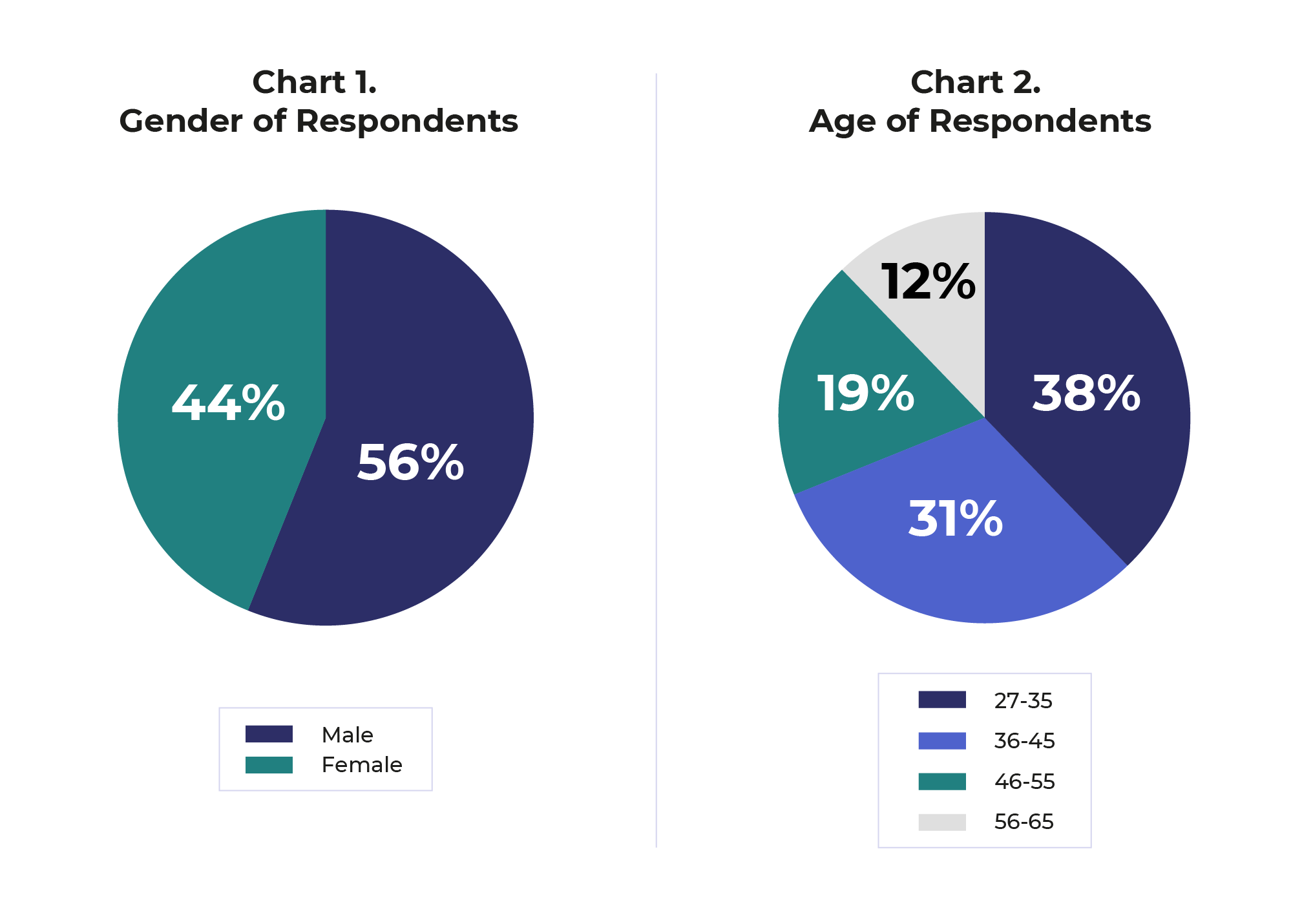
The respondent profile reflects balanced gender representation, which is important for interpreting the results in a social context. The age structure shows a predominance of active professional groups engaged in digital transformation processes. The largest cohort is aged 27-35, representing a generation of specialists already working in an environment where digital solutions are widely adopted. A significant portion of participants also falls within the 36-45 age group, consisting primarily of mid- and senior-level managers, analysts, and experts across various professional fields.
The respondent profile reflects balanced gender representation, which is important for interpreting the results in a social context. The age structure shows a predominance of active professional groups engaged in digital transformation processes. The largest cohort is aged 27-35, representing a generation of specialists already working in an environment where digital solutions are widely adopted. A significant portion of participants also falls within the 36-45 age group, consisting primarily of mid- and senior-level managers, analysts, and experts across various professional fields.
Most surveyed experts demonstrate a high or medium level of involvement in digitalization processes (83%). This creates a favorable basis for more accurate assessments, as their perception of artificial intelligence relies not only on theoretical knowledge but also on practical experience. Notably, only 13% of respondents report low involvement, which indicates a targeted sample and the professional orientation of the study. Therefore, the expert evaluations in this research reflect not an abstract perception, but the views of individuals directly engaged in digital transformation at various levels.
PERCEPTION OF ARTIFICIAL INTELLIGENCE BY KAZAKHSTAN’S EXPERTS
The perspectives of Kazakhstan’s expert community on artificial intelligence are shaped by the rapid pace of digital transformation and the growing demand for technologies capable of improving governance quality, economic efficiency, and the level of social services. At the same time, experts demonstrate not only a high level of awareness of the phenomenon of artificial intelligence itself, but also a balanced understanding of how these technologies are perceived by society, what expectations surround them, and how prepared the professional environment is to adopt and use them.
Experts’ level of engagement in digitalization is also high. The study shows that most actively work with data, digital services, and analytical tools, reflecting an overall shift toward data-driven management. At the same time, experts note that this engagement is not always supported institutionally or organizationally, creating a gap between individual readiness and the systemic capacity to implement artificial intelligence across different professional fields.
It is also important to highlight the personal readiness of specialists to use artificial intelligence. Respondents’ answers indicate that the professional environment is already adapting to new technologies and sees artificial intelligence not as a distant prospect, but as a daily work tool. This underscores the potential of the expert community to act as a driver for artificial intelligence adoption.
Experts’ level of engagement in digitalization is also high. The study shows that most actively work with data, digital services, and analytical tools, reflecting an overall shift toward data-driven management. At the same time, experts note that this engagement is not always supported institutionally or organizationally, creating a gap between individual readiness and the systemic capacity to implement artificial intelligence across different professional fields.
It is also important to highlight the personal readiness of specialists to use artificial intelligence. Respondents’ answers indicate that the professional environment is already adapting to new technologies and sees artificial intelligence not as a distant prospect, but as a daily work tool. This underscores the potential of the expert community to act as a driver for artificial intelligence adoption.
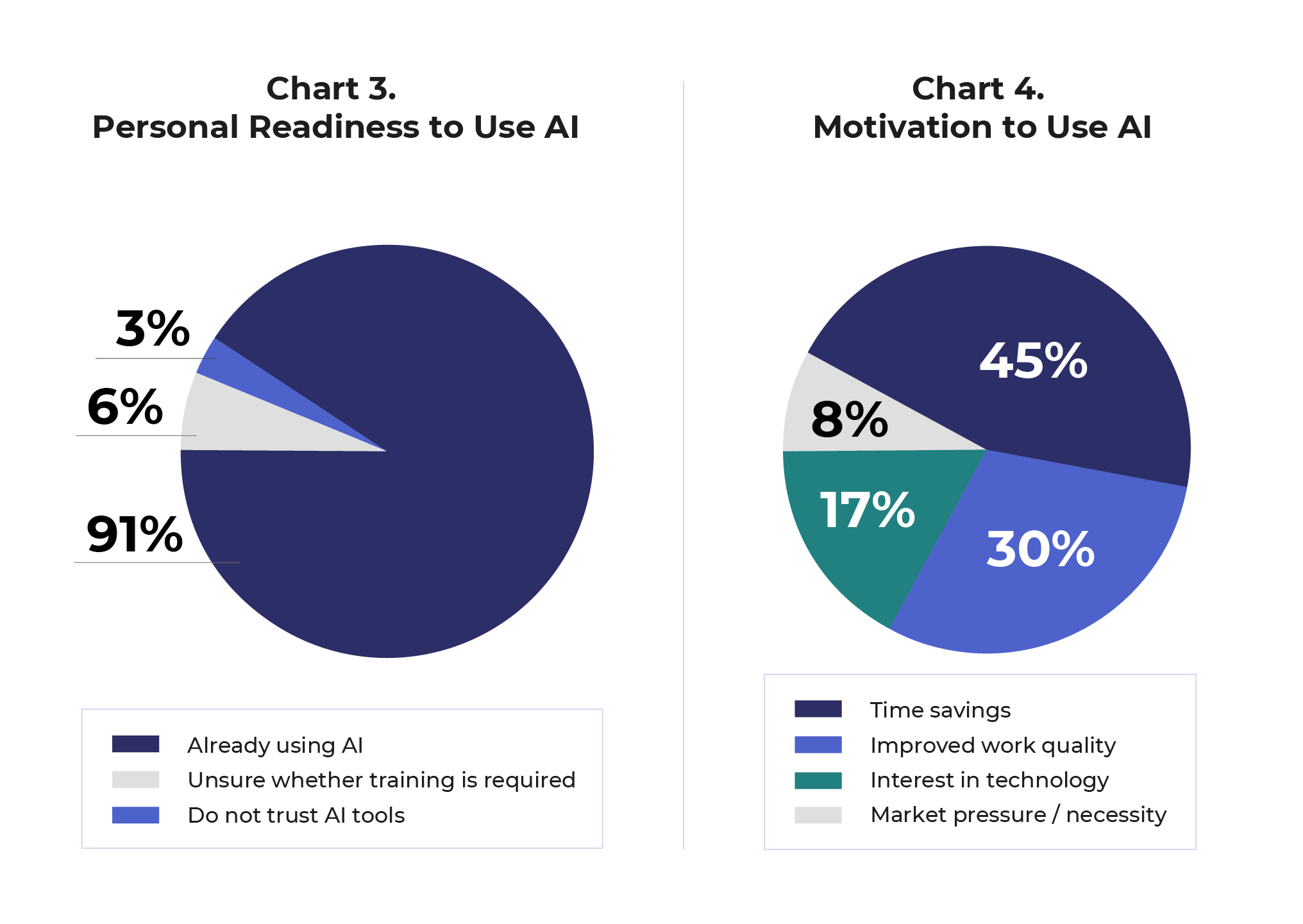
More than 90% of respondents report full or partial readiness to apply artificial intelligence in their professional activities. Responses show that motivation is predominantly pragmatic: experts use artificial intelligence not for experimentation, but to optimize tasks, improve decision quality, accelerate analytics, and reduce routine work. The most frequently cited motivations include the need to work faster and more accurately, process large volumes of information, and acquire new competencies to meet evolving market demands.
At the same time, respondents emphasize that readiness depends not only on the availability of tools but also on access to high-quality data, reliable services, appropriate security policies, and clear ethical standards. The most popular tools remain text-based models (ChatGPT, Gemini), followed by visual generators (Midjourney, Leonardo), tools for working with presentations and documents, and platforms for data processing. This distribution confirms that artificial intelligence has become a practical work tool across all segments, from public administration to education and business.
At the same time, respondents emphasize that readiness depends not only on the availability of tools but also on access to high-quality data, reliable services, appropriate security policies, and clear ethical standards. The most popular tools remain text-based models (ChatGPT, Gemini), followed by visual generators (Midjourney, Leonardo), tools for working with presentations and documents, and platforms for data processing. This distribution confirms that artificial intelligence has become a practical work tool across all segments, from public administration to education and business.
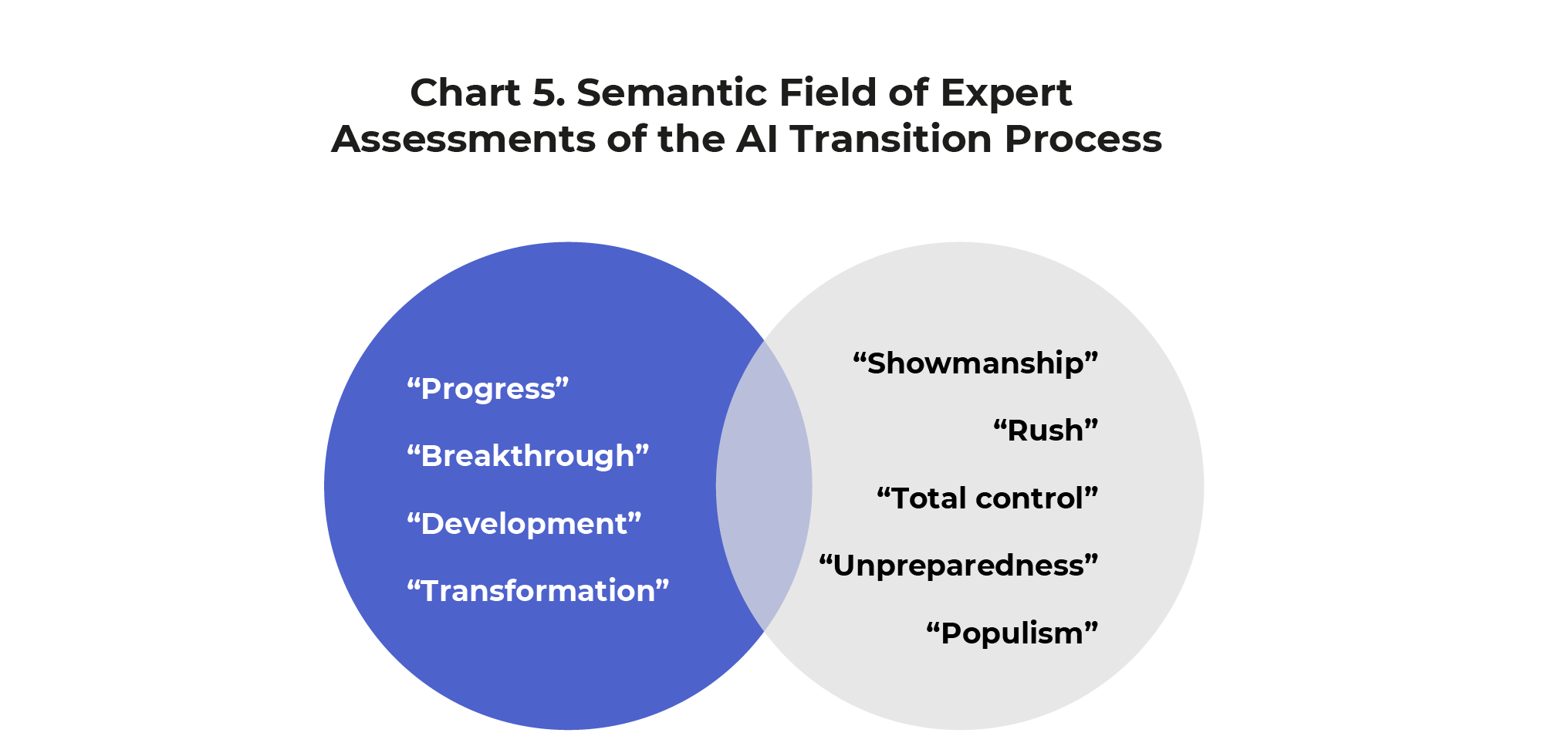
In the course of the study, experts were asked to describe Kazakhstan’s transition to artificial intelligence in a single word. Analysis of this open-ended question showed that a moderately positive attitude predominates within the expert community. Frequently mentioned words such as “progress,” “breakthrough”, “development”, and “transformation” indicate that most experts perceive artificial intelligence as a natural stage of modernization, capable of giving an impetus to the accelerated development of public services and the economy.
However, a significant portion of responses reflects caution. Words such as “showmanship”, “rush”, “total control”, “unpreparedness”, and “populism” highlight concerns not about artificial intelligence as a technology, but about the quality of management decisions, the risks of superficial implementation, and potential social imbalances.
Thus, experts’ perception of artificial intelligence can be described as a balance of expectations and concerns. Artificial intelligence is seen as a powerful tool, but the success of its implementation depends entirely on the maturity of institutions, the availability of skilled personnel, and the data architecture.
However, a significant portion of responses reflects caution. Words such as “showmanship”, “rush”, “total control”, “unpreparedness”, and “populism” highlight concerns not about artificial intelligence as a technology, but about the quality of management decisions, the risks of superficial implementation, and potential social imbalances.
Thus, experts’ perception of artificial intelligence can be described as a balance of expectations and concerns. Artificial intelligence is seen as a powerful tool, but the success of its implementation depends entirely on the maturity of institutions, the availability of skilled personnel, and the data architecture.

DRIVERS OF OPTIMISM: WHERE EXPERTS SEE POTENTIAL OF ARTIFICIAL INTELLIGENCE
The perception of artificial intelligence among experts in Kazakhstan is characterized by rational optimism, grounded not in abstract expectations but in specific functional changes that can enhance governance, modernize the economy, and improve citizens’ quality of life. Experts primarily view artificial intelligence as a tool that addresses accumulated systemic problems, such as fragmented data, slow administrative procedures, and other inefficiencies. The data indicate that experts’ optimism reflects real institutional needs and an understanding of which processes can be transformed most quickly through modern technologies.
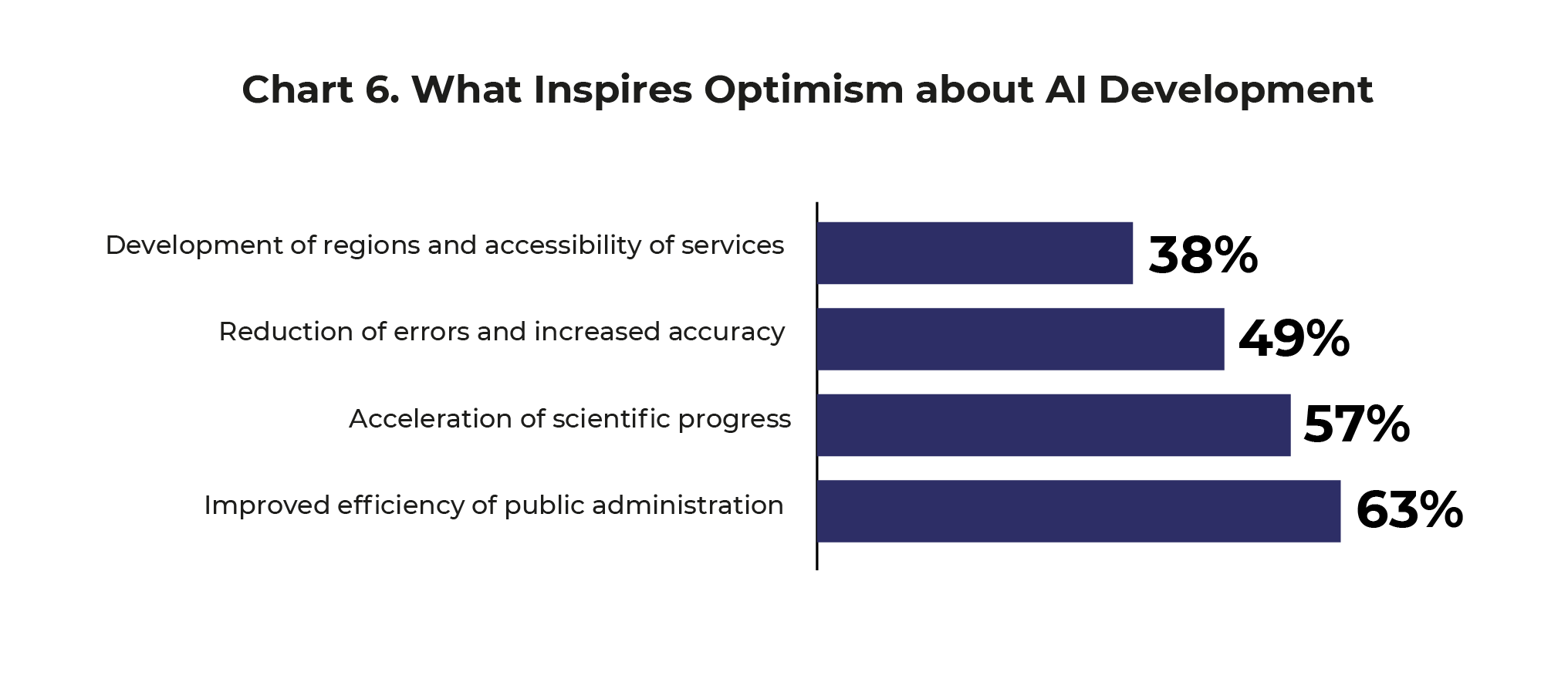
Respondents were allowed to select up to three options, so the total percentages exceed 100%, reflecting the intensity of overlapping opinions.
Experts most frequently associate artificial intelligence with institutional improvement potential. The highest expectations relate to enhancing government efficiency – accelerating processes, reducing bureaucratic costs, minimizing errors, and increasing decision-making accuracy. A second major cluster of expectations concerns scientific progress, highlighting the demand for technological research and the development of homegrown intellectual assets in Kazakhstan.
If the previous chart illustrates why experts are optimistic, the following diagrams show where this potential is likely to be most visible.
Experts most frequently associate artificial intelligence with institutional improvement potential. The highest expectations relate to enhancing government efficiency – accelerating processes, reducing bureaucratic costs, minimizing errors, and increasing decision-making accuracy. A second major cluster of expectations concerns scientific progress, highlighting the demand for technological research and the development of homegrown intellectual assets in Kazakhstan.
If the previous chart illustrates why experts are optimistic, the following diagrams show where this potential is likely to be most visible.
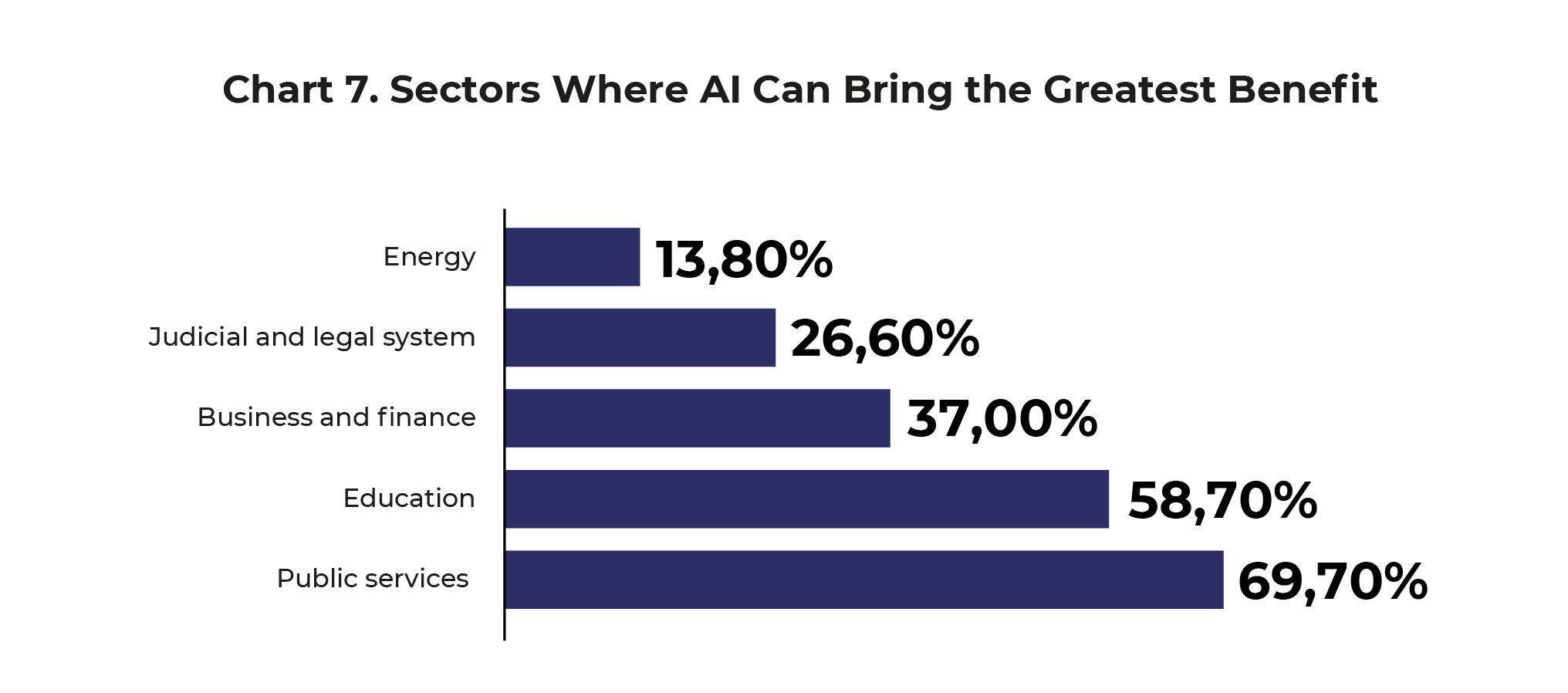
Respondents were allowed to select up to three options, so the total percentages exceed 100%, reflecting the intensity of overlapping opinions.
The sector considered most promising is public services. A large volume of data and standardized procedures already exists, making artificial intelligence a natural tool for improving service quality, automating processes, and addressing inefficiencies.
The sector considered most promising is public services. A large volume of data and standardized procedures already exists, making artificial intelligence a natural tool for improving service quality, automating processes, and addressing inefficiencies.

High expectations also exist in education, where artificial intelligence can support personalized learning and analyze educational trajectories. In business, medicine, and law enforcement, artificial intelligence’s potential is linked to big data analysis, forecasting, and operational analytics.

Comparison of Charts 7 and 8 reveals an important gap. In areas where experts see the greatest potential (public services, education), artificial intelligence adoption remains limited. The most active adoption occurs in the private sector, where businesses respond more quickly to technological trends and have more flexible processes for experimenting with new tools.
Experts view the future labor market as transformative but not catastrophic. Most believe artificial intelligence will change the structure of professions rather than lead to mass unemployment. Rising demand for specialists in data, engineering, analytics, and technology management is a key finding. A notable share of respondents anticipates the emergence of new professions, such as artificial intelligence system developers, algorithm auditors, artificial intelligence ethics specialists, and digital process managers.
Experts view the future labor market as transformative but not catastrophic. Most believe artificial intelligence will change the structure of professions rather than lead to mass unemployment. Rising demand for specialists in data, engineering, analytics, and technology management is a key finding. A notable share of respondents anticipates the emergence of new professions, such as artificial intelligence system developers, algorithm auditors, artificial intelligence ethics specialists, and digital process managers.
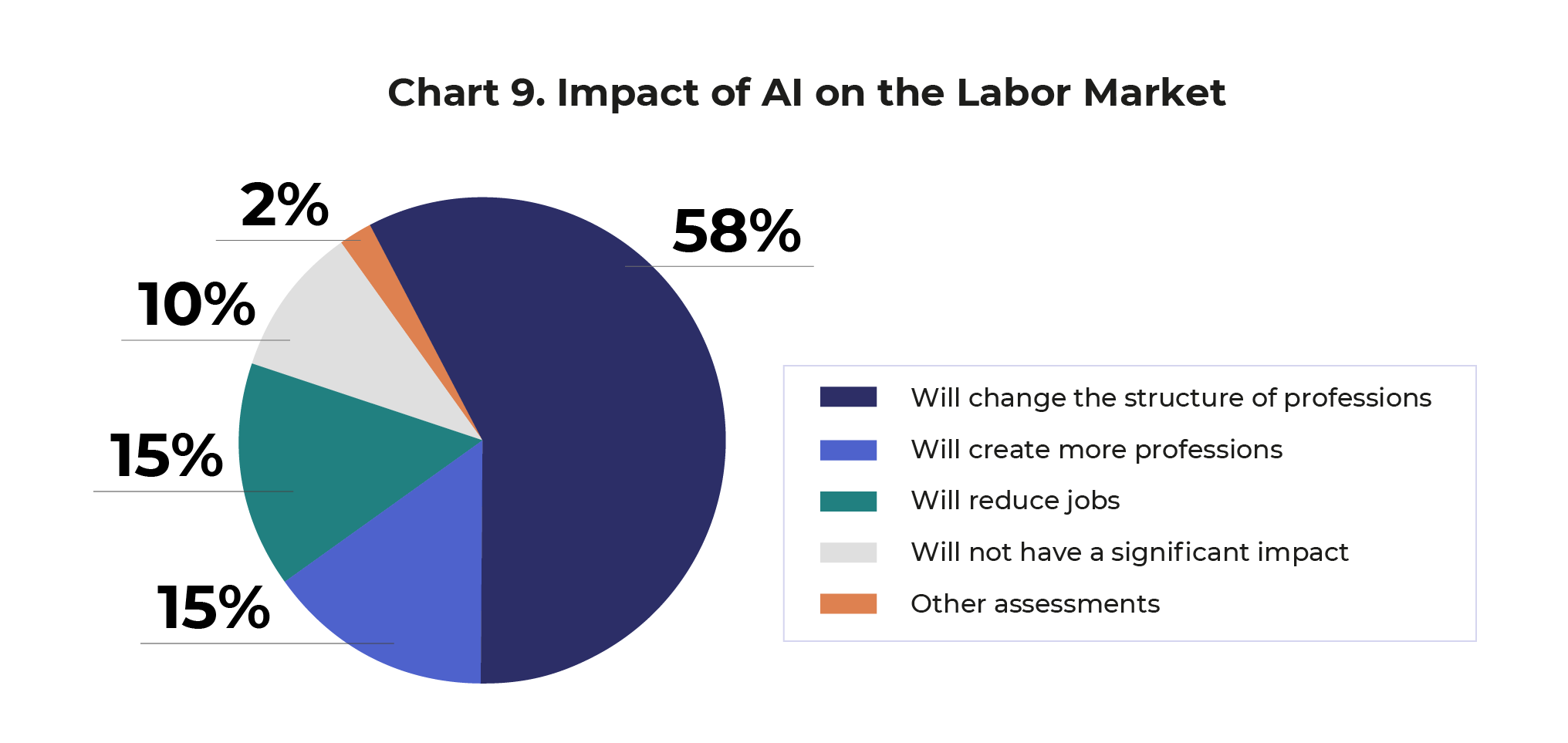
Overall, the study shows that the expert community sees artificial intelligence’s main advantages in its process qualities – accuracy, speed, analytics, and operational efficiency. Optimism is centered on expectations of rapid and tangible improvements that can be implemented in the coming years. This optimism is based on three key dimensions: institutional potential (faster public services, fewer errors, digital modernization), technological potential (advancement in science, analytics, and research capabilities), socio-economic potential (improved quality of life, new services, and increased business efficiency).
RISKS AND BARRIERS TO IMPLEMENTATION OF ARTIFICIAL INTELLIGENCE IN KAZAKHSTAN
The transition to widespread use of artificial intelligence in government and the economy requires not only technological readiness but also high institutional maturity. Expert survey data indicate that perceptions of risks and barriers among specialists form a fairly balanced picture. The threats are viewed not as abstract “dangers” inherent to algorithms themselves, but as derivatives of the quality of governance, data, regulation, and the readiness of individual sectors.
Expert assessments highlight four groups of issues that most strongly shape the trajectory of artificial intelligence adoption in Kazakhstan: general risks of artificial intelligence development, systemic barriers, sectors least prepared for implementation, and data management risks, which represent a key architectural vulnerability of the entire ecosystem.
These elements are interconnected: as industry weaknesses amplify barriers, barriers increase risks, and data risks make it impossible to scale solutions. Taken together, the results indicate the need for a comprehensive approach to artificial intelligence policy development.
Expert assessments highlight four groups of issues that most strongly shape the trajectory of artificial intelligence adoption in Kazakhstan: general risks of artificial intelligence development, systemic barriers, sectors least prepared for implementation, and data management risks, which represent a key architectural vulnerability of the entire ecosystem.
These elements are interconnected: as industry weaknesses amplify barriers, barriers increase risks, and data risks make it impossible to scale solutions. Taken together, the results indicate the need for a comprehensive approach to artificial intelligence policy development.
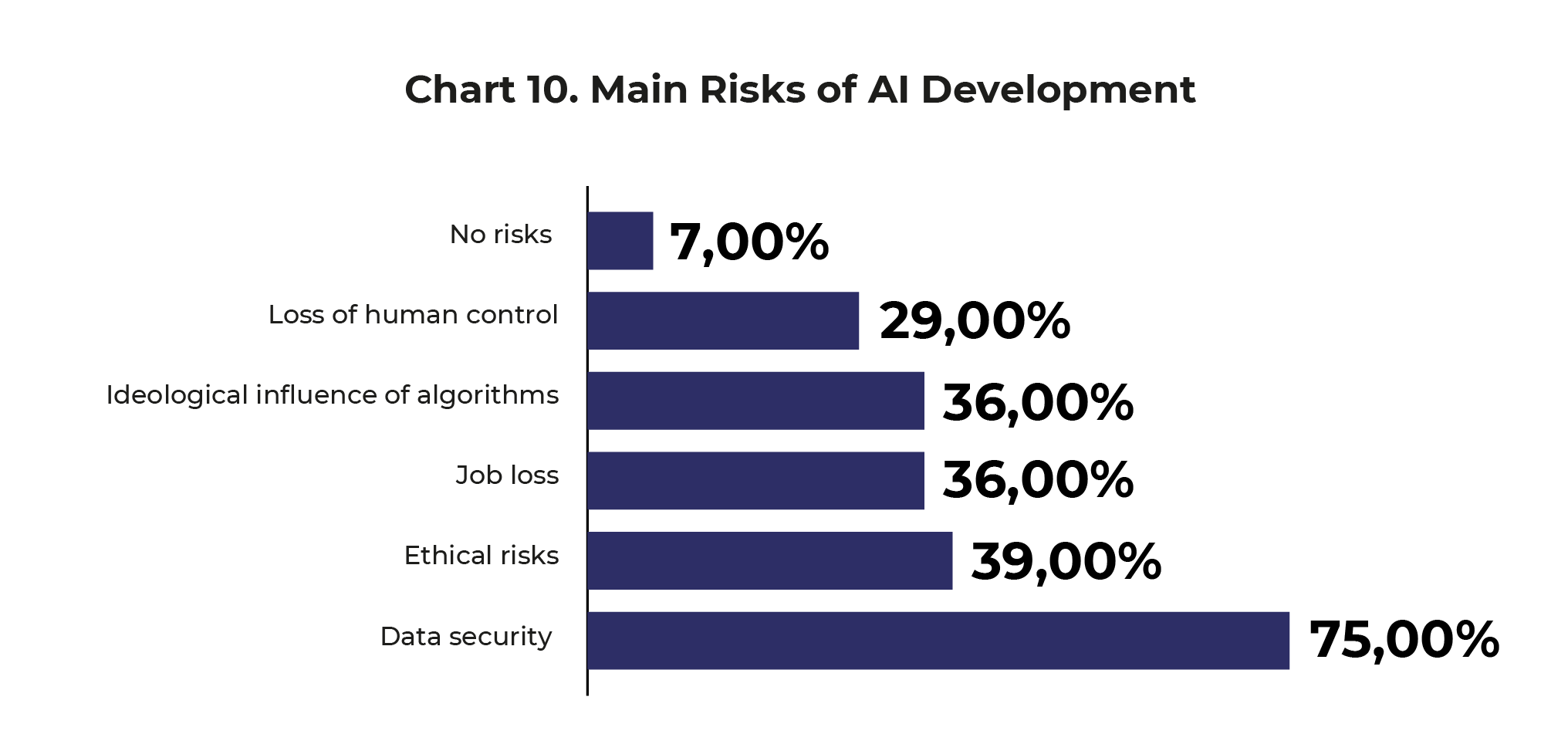
Expert concerns are primarily focused on data and privacy. This is the dominant issue – three-quarters of respondents identify data leaks, unauthorized access, and weak protection as a critical risk. Ethical risks, such as discrimination of models and opaque decision-making, are the second most significant category of threats.
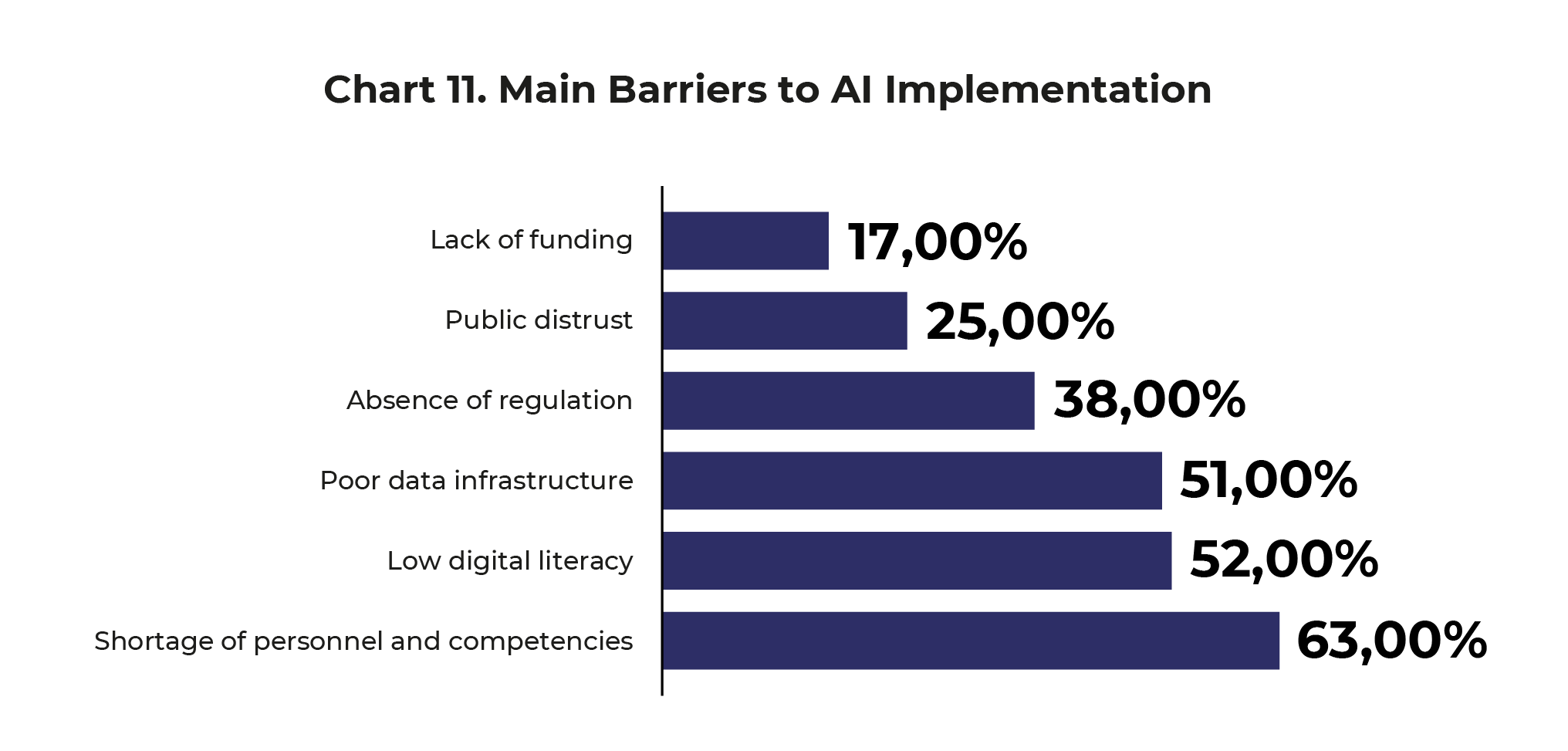
The barriers reveal a different dimension, in which experts see human capital and institutional readiness as the primary limiting factors. A lack of competencies and low digital literacy are key structural bottlenecks limiting artificial intelligence adoption.
Importantly, financial constraints rank lowest, indicating that the challenge is not budgets but systemic processes and workforce qualifications.
Importantly, financial constraints rank lowest, indicating that the challenge is not budgets but systemic processes and workforce qualifications.
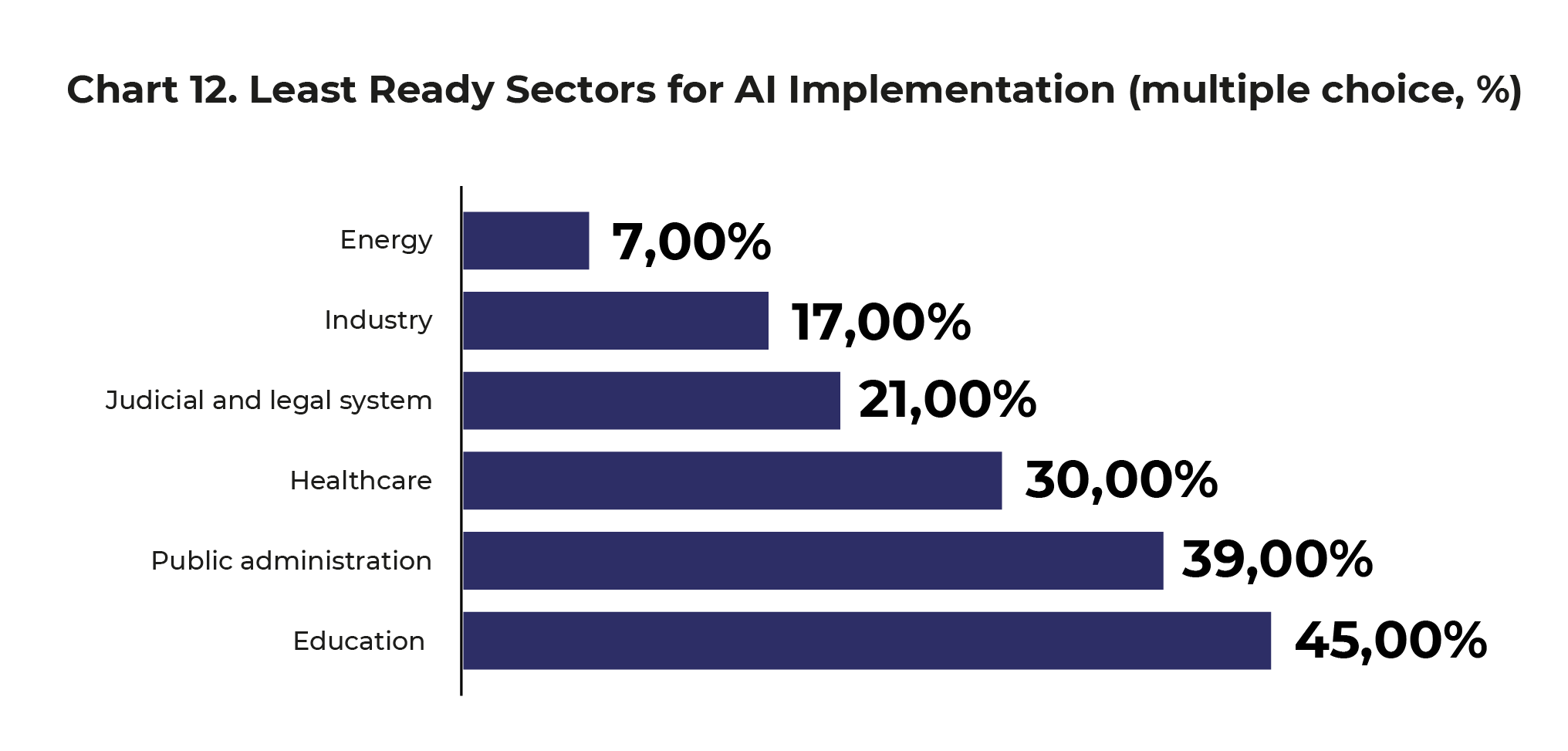
The “least prepared industries” illustrate the flip side of barriers. The sectors most systemically vulnerable are education and public administration – precisely where artificial intelligence could have the greatest impact. This reveals a gap between potential and reality. It is precisely in those areas where artificial intelligence could bring the greatest benefits that it encounters the strongest resistance from the environment. Healthcare and the judicial system are also perceived as insufficiently prepared, largely due to requirements for data quality, ethical accountability, and the absence of digital standards.
In conclusion, expert assessments indicate that key risks and barriers to artificial intelligence adoption in Kazakhstan are not driven by fear of the technology itself, but by institutional vulnerabilities – including data quality, regulation, competencies, and sectoral readiness. The country’s transition to an AI-Gov model will only be possible with the creation of secure and standardized data systems, the development of a sustainable workforce architecture for artificial intelligence implementation, the development of a unified regulatory framework, and the achievement by industries of a level of digital maturity that will allow for the systemic, rather than piecemeal, integration of artificial intelligence.
In conclusion, expert assessments indicate that key risks and barriers to artificial intelligence adoption in Kazakhstan are not driven by fear of the technology itself, but by institutional vulnerabilities – including data quality, regulation, competencies, and sectoral readiness. The country’s transition to an AI-Gov model will only be possible with the creation of secure and standardized data systems, the development of a sustainable workforce architecture for artificial intelligence implementation, the development of a unified regulatory framework, and the achievement by industries of a level of digital maturity that will allow for the systemic, rather than piecemeal, integration of artificial intelligence.
ASSESSMENT OF THE ACTIVITIES OF THE MINISTRY OF ARTIFICIAL INTELLIGENCE AND DIGITAL DEVELOPMENT OF THE REPUBLIC OF KAZAKHSTAN
The study also demonstrates that the overall attitude of the expert community toward the work of the Ministry of Artificial Intelligence and Digital Development is predominantly skeptical. Evaluations were conducted using a five-point scale (from 1 to 5), similar to a “star rating”, where 1 indicates a very low assessment and 5 denotes maximum approval.
The average score for the Ministry’s performance was 2.86 out of 5, indicating a predominance of critical perceptions and a general sense of underdeveloped management processes. Although the most frequent individual rating remains “3” (35%), the overall average reflects a systematic prevalence of low and medium scores. Combined, the ratings of 1, 2, and 3 account for 73% of all responses, demonstrating a dominance of dissatisfaction and skepticism.
In their comments, experts highlighted issues such as lack of transparency, weak communication with the expert community, unclear strategic priorities, and a persistent imbalance between media visibility and real results. High ratings (“4” and “5”) make up only 27% of responses, and even these, according to open-ended answers, mainly reflect expectations of future improvements, rather than approval of the current quality of the Ministry’s work.
Analysis of open-ended comments allowed the identification of key areas where experts see potential for improving the work of the Ministry of Artificial Intelligence and Digital Development. These suggestions reflect the practical experience of specialists and highlight the most common expectations of the professional community. The main areas that respondents propose for improvement in the work of the Ministry of Artificial Intelligence and Digital Development of the Republic of Kazakhstan are:
The average score for the Ministry’s performance was 2.86 out of 5, indicating a predominance of critical perceptions and a general sense of underdeveloped management processes. Although the most frequent individual rating remains “3” (35%), the overall average reflects a systematic prevalence of low and medium scores. Combined, the ratings of 1, 2, and 3 account for 73% of all responses, demonstrating a dominance of dissatisfaction and skepticism.
In their comments, experts highlighted issues such as lack of transparency, weak communication with the expert community, unclear strategic priorities, and a persistent imbalance between media visibility and real results. High ratings (“4” and “5”) make up only 27% of responses, and even these, according to open-ended answers, mainly reflect expectations of future improvements, rather than approval of the current quality of the Ministry’s work.
Analysis of open-ended comments allowed the identification of key areas where experts see potential for improving the work of the Ministry of Artificial Intelligence and Digital Development. These suggestions reflect the practical experience of specialists and highlight the most common expectations of the professional community. The main areas that respondents propose for improvement in the work of the Ministry of Artificial Intelligence and Digital Development of the Republic of Kazakhstan are:
1.Digital Infrastructure, Data, and Security
Most recommendations relate to strengthening the “foundation” of digital development. Experts emphasize the importance of sustainable infrastructure, including high-quality internet, reliable data centers, modern electronic archiving, effective data management, and enhanced cybersecurity. It is noted that without addressing these fundamental issues, any artificial intelligence initiatives risk being fragmented, ineffective, or unsafe.
2.Transparency, Strategy, and Interagency Coordination
A significant share of the comments relates to strategic governance. Respondents point to the need for a clear and coherent strategy – including more clearly defined functions of the ministry, delineated areas of responsibility between agencies, and a systemic logic behind the projects. Requests were made for the publication of plans, reports, KPIs, the development of feedback mechanisms, and the creation of tools for public and expert oversight.
3.Human Capital, Education, and Digital Culture
Experts emphasize the importance of developing human capital. Recommendations include moving from formal courses to competency-based educational programs, industry-specific training, and improving digital literacy – especially in regional areas.
Most recommendations relate to strengthening the “foundation” of digital development. Experts emphasize the importance of sustainable infrastructure, including high-quality internet, reliable data centers, modern electronic archiving, effective data management, and enhanced cybersecurity. It is noted that without addressing these fundamental issues, any artificial intelligence initiatives risk being fragmented, ineffective, or unsafe.
2.Transparency, Strategy, and Interagency Coordination
A significant share of the comments relates to strategic governance. Respondents point to the need for a clear and coherent strategy – including more clearly defined functions of the ministry, delineated areas of responsibility between agencies, and a systemic logic behind the projects. Requests were made for the publication of plans, reports, KPIs, the development of feedback mechanisms, and the creation of tools for public and expert oversight.
3.Human Capital, Education, and Digital Culture
Experts emphasize the importance of developing human capital. Recommendations include moving from formal courses to competency-based educational programs, industry-specific training, and improving digital literacy – especially in regional areas.

Particular emphasis is placed on a “human-centered artificial intelligence” approach: balancing technology and ethics, ensuring responsible implementation, and maintaining a focus on public interests.
4.Practical Applicability and Reduction of “Media-Coverage”
Many respondents criticized the excessive number of declarative initiatives, memoranda, and announcements without subsequent implementation. They emphasize the need to move from statements to practical solutions: sectoral pilots, digital services, city and regional projects with clear performance metrics. Respondents note that an excessive focus on media activities and populism reduces trust and distracts from real work. Overall, the picture suggests that experts do not reject the Ministry; rather, they expect maturity. High ratings and positive elements reflect trust in the very idea of creating an artificial intelligence institution. Medium ratings indicate an early stage in the Ministry’s development, where growth challenges are already visible. Low ratings reflect criticism of management decisions, not skepticism toward artificial intelligence itself.
In summary, experts want the Ministry of Artificial Intelligence and Digital Development to be seen not as a symbol of digital modernization, but as a center of competencies, data, infrastructure, and honest engagement with society and business.
4.Practical Applicability and Reduction of “Media-Coverage”
Many respondents criticized the excessive number of declarative initiatives, memoranda, and announcements without subsequent implementation. They emphasize the need to move from statements to practical solutions: sectoral pilots, digital services, city and regional projects with clear performance metrics. Respondents note that an excessive focus on media activities and populism reduces trust and distracts from real work. Overall, the picture suggests that experts do not reject the Ministry; rather, they expect maturity. High ratings and positive elements reflect trust in the very idea of creating an artificial intelligence institution. Medium ratings indicate an early stage in the Ministry’s development, where growth challenges are already visible. Low ratings reflect criticism of management decisions, not skepticism toward artificial intelligence itself.
In summary, experts want the Ministry of Artificial Intelligence and Digital Development to be seen not as a symbol of digital modernization, but as a center of competencies, data, infrastructure, and honest engagement with society and business.
EXPERT RECOMMENDATIONS FOR ACCELERATING AND ENSURING THE ETHICAL ADOPTION OF ARTIFICIAL INTELLIGENCE IN KAZAKHSTAN
Analysis of experts’ open-ended responses reveals three major clusters of recommendations around which professional consensus emerges. Although the formulations were open-ended, a clear structure of priorities can be observed, allowing the identification of key directions for policy development of artificial intelligence in Kazakhstan.
1. Institutional Environment and Regulation
Experts agree that the sustainable adoption of artificial intelligence is impossible without the establishment of a predictable legal environment and clear rules for all participants in the ecosystem. Their assessments show a strong demand for systematic regulation – one that is not restrictive, but guiding. At the same time, experts emphasize that institutional weakness cannot be compensated for by technological investments or demonstration projects.
Particular attention is given to the issue of trust as a key institutional resource. International experience shows that trust in digital systems is a prerequisite for scaling technologies, and Kazakhstan’s experts fully share this view. They see artificial intelligence not as a neutral infrastructure, but as a tool that affects the fundamental rights of citizens, especially in the areas of personal data and automated decision-making.
1. Institutional Environment and Regulation
Experts agree that the sustainable adoption of artificial intelligence is impossible without the establishment of a predictable legal environment and clear rules for all participants in the ecosystem. Their assessments show a strong demand for systematic regulation – one that is not restrictive, but guiding. At the same time, experts emphasize that institutional weakness cannot be compensated for by technological investments or demonstration projects.
Particular attention is given to the issue of trust as a key institutional resource. International experience shows that trust in digital systems is a prerequisite for scaling technologies, and Kazakhstan’s experts fully share this view. They see artificial intelligence not as a neutral infrastructure, but as a tool that affects the fundamental rights of citizens, especially in the areas of personal data and automated decision-making.
“To accelerate and ensure the more ethical adoption of artificial intelligence in Kazakhstan, the focus should be not on the number of pilot projects but on the quality of the institutional environment. First and foremost, it is necessary to establish transparent rules of the game, adopt a law on data and algorithms, define accountability for automated decisions, approve an ethical code, and introduce mandatory expert review of all AI projects, especially in public services. Building trust is essential: the state must explain how and why artificial intelligence is used, publish data and results, and ensure that citizens can exercise control over the technologies” (expert, open-ended response)
This position is supported by many survey participants, who highlight the need for legally mandated independent evaluation of projects, ethical standards, and risk assessment procedures. They note that in the absence of institutional safeguards, artificial intelligence becomes a source of governance errors and social vulnerability.
“Initiate the development of ethical standards and mechanisms for civil oversight of the use of artificial intelligence algorithms. As part of this work, it is advisable to prepare:
1) an AI Code for public officials defining norms of responsible and transparent use of algorithms in decision-making;
2) an AI Guide for citizens aimed at improving digital literacy, awareness, and legal protection of the population;
3) an AI Procedure for quasi-state and private sector entities establishing principles of ethics, accountability, and prevention of discriminatory practices.
Introducing such documents will help form a unified culture of responsible AI use, strengthen public trust in digital innovation, and ensure a balance between technological development and the protection of citizens’ rights” (expert, open-ended response)
Experts further stress that ethics does not slow down development – it enhances its sustainability.
“Ethics and speed do not contradict each other. Transparency and accountability create trust, and trust accelerates adoption. Kazakhstan can become a country where artificial intelligence evolves together with society. Kazakhstanis quickly embrace the benefits of new technologies. What matters is that these technologies remain fair, useful, and understandable to everyone” (expert, open-ended response)
Another important regulatory direction identified by respondents is the coordination of public policy on artificial intelligence. Many comments point to the fragmented nature of current initiatives and the lack of a single center of responsibility. In this context, experts propose establishing a coordinating body or project office to ensure cross-cutting oversight, strategic coherence, and the elimination of institutional fragmentation.
At the same time, several experts express concern about the excessive role of the state as a technological driver. They emphasize that the state should not dictate solutions, but rather set the framework conditions and ensure accountability.
At the same time, several experts express concern about the excessive role of the state as a technological driver. They emphasize that the state should not dictate solutions, but rather set the framework conditions and ensure accountability.
“Remove the state from the role of trendsetter in AI implementation. Ensure collaboration with businesses, which are the actual developers of such systems, and analyze all measures to ensure proper and non-discriminatory regulation” (expert, open-ended response)
Particularly strong criticism is directed at showcase projects implemented for reporting purposes rather than public benefit. Experts stress the need to abandon campaigns, imitations, and projects lacking operational value.
“Stop unsystematic work, wasteful spending, and inflating bubbles out of empty projects; ensure support for many small, young companies with real potential and create conditions for their development, instead of turning the public sector into a monopoly of companies with administrative influence” (expert, open-ended response)
Thus, in the experts’ perception, regulation of artificial intelligence should be grounded not in control for control’s sake, but in institutional maturity, legal clarity, and social accountability.
2. Human Capital, Education, and Digital Culture
The second structural block of recommendations concerns human capital as the foundation of technological sovereignty. Experts unanimously emphasize that without a systemic educational policy, artificial intelligence cannot become a sustainable development pathway and will remain an externally imported technology.
Education is understood not narrowly as the training of IT specialists, but far more broadly – as the development of digital thinking, critical assessment skills, and ethical awareness. The responses reflect a clear understanding that artificial intelligence is not only an engineering task but also a managerial, legal, and humanitarian challenge.
2. Human Capital, Education, and Digital Culture
The second structural block of recommendations concerns human capital as the foundation of technological sovereignty. Experts unanimously emphasize that without a systemic educational policy, artificial intelligence cannot become a sustainable development pathway and will remain an externally imported technology.
Education is understood not narrowly as the training of IT specialists, but far more broadly – as the development of digital thinking, critical assessment skills, and ethical awareness. The responses reflect a clear understanding that artificial intelligence is not only an engineering task but also a managerial, legal, and humanitarian challenge.

“Develop human capital: train specialists and managers to work with AI and make data-driven decisions without losing human expertise, so that AI accelerates – rather than replace – the thinking process” (expert, open-ended response)
This concerns not only digital skills but the ability to make decisions in conditions of automation. Humans must remain agents, not passive users of algorithms. In addition, many experts highlight the need for mass public education.
“Nothing but basic digital literacy will help, because all technologies and services are not local” (expert, open-ended response)
Experts stress that the population does not yet have a stable understanding of the risks and boundaries of artificial intelligence use, which leads to false expectations and uncritical consumption of digital services.
“It is hard to imagine this process being ‘ethical,’ and this is not only the fault of implementers – users themselves still don’t understand what information they can share with AI and what should remain private” (expert, open-ended response)
A separate focus is placed on early education. The answers emphasize the need to integrate artificial intelligence into school curricula – not as a tool for creating presentations, but as a means of understanding the logic of algorithms, models, and responsibility. Thus, in the experts’ rhetoric, education is not an accompaniment to technological policy but its core component.
“Start with schools. Explain that AI is not a panacea” (expert, open-ended response)
“Teach AI in schools alongside robotics classes. Develop partnerships with IT and creative hubs” (expert, open-ended response)
3. Data, Infrastructure and the Technological Ecosystem
The third group of recommendations reflects a professional understanding of the limitations of the technical base. Experts emphasize that artificial intelligence cannot exist without data, and data cannot exist without infrastructure. Infrastructure is viewed not only as internet and servers, but as systems of storage, security, and access management. The protection of personal data is highlighted as a top priority. Without trust in the infrastructure, any technological project loses legitimacy. For this reason, experts insist on the development of national data processing centers, backup scenarios, and well-designed data storage architectures.
The third group of recommendations reflects a professional understanding of the limitations of the technical base. Experts emphasize that artificial intelligence cannot exist without data, and data cannot exist without infrastructure. Infrastructure is viewed not only as internet and servers, but as systems of storage, security, and access management. The protection of personal data is highlighted as a top priority. Without trust in the infrastructure, any technological project loses legitimacy. For this reason, experts insist on the development of national data processing centers, backup scenarios, and well-designed data storage architectures.
“It is important to thoroughly consider the security of personal data, develop a safe data processing center system, and have a Plan B in case of a strong geomagnetic event or other force majeure” (expert, open-ended response)
Digital inequality is raised with equal frequency. The lack of stable internet in the regions is seen as a direct threat to the digital divide.
“Without high-quality internet in remote rural areas, and even on the outskirts of cities, the population will not be able to use AI to its full potential” (expert, open-ended response)
Experts also emphasize technological sovereignty. Having domestic AI infrastructure and language models is viewed as a strategic necessity rather than an element of prestige.
“Kazakhstan must have its own AI model” (expert, open-ended response)
Additionally, the sustainability of AI development is linked not to the number of implementations but to the quality of data architecture and the openness of the ecosystem. Taken together, the expert recommendations portray artificial intelligence not as an industrial breakthrough but as a process of social rethinking of technology. The overarching principle is human-centeredness.
“Kazakhstan needs a ‘Human-Centered AI Course’. Not just digitalization, but meaningful technology adoption where: AI serves society; decisions are transparent and explainable; and development does not detach from moral foundations” (expert, open-ended response)
Thus, the professional community perceives artificial intelligence not as an autonomous engineering field, but as part of a broader social reform that requires mature institutions, competent governance, and cultural transformation.

CONCLUSION